Systems · Riverclack
Riverclack Standing-Seam Roof
A patented standing-seam lock with no through-fasteners — long spans, absolute watertightness, Italian engineering since 1987.
Introduction
A patented standing-seam lock with no through-fasteners — long spans, absolute watertightness, Italian engineering since 1987.
iverclack standing-seam roofing is the flagship metal roof system from Riverclack SpA (Italy, since 1987). The lock geometry is patented: adjacent sheets are joined mechanically with the installer's foot, with no screws, no rivets and no perforation of the metal. The result is a watertight roofing blanket over long spans with no single potential point of leakage. According to the manufacturer, more than 18.4 million square metres of roofing have been installed with this technology across 35+ countries — including the Irina Viner-Usmanova Rhythmic Gymnastics Palace in Moscow.
The base material is EN AW 5754-H18 aluminium 0.7 mm thick; copper, stainless steel, zinc-titanium and polymer-coated galvanised steel are also available. Standard sheet widths are 500, 550 and 600 mm; bespoke tapered sheets are made to order from 170 to 550 mm at the ends. Terra-Zenith is the authorised Riverclack dealer in the Russian Federation: detail design, factory supply and installation supervision are delivered from a single point of accountability.
How the patented Riverclack lock works
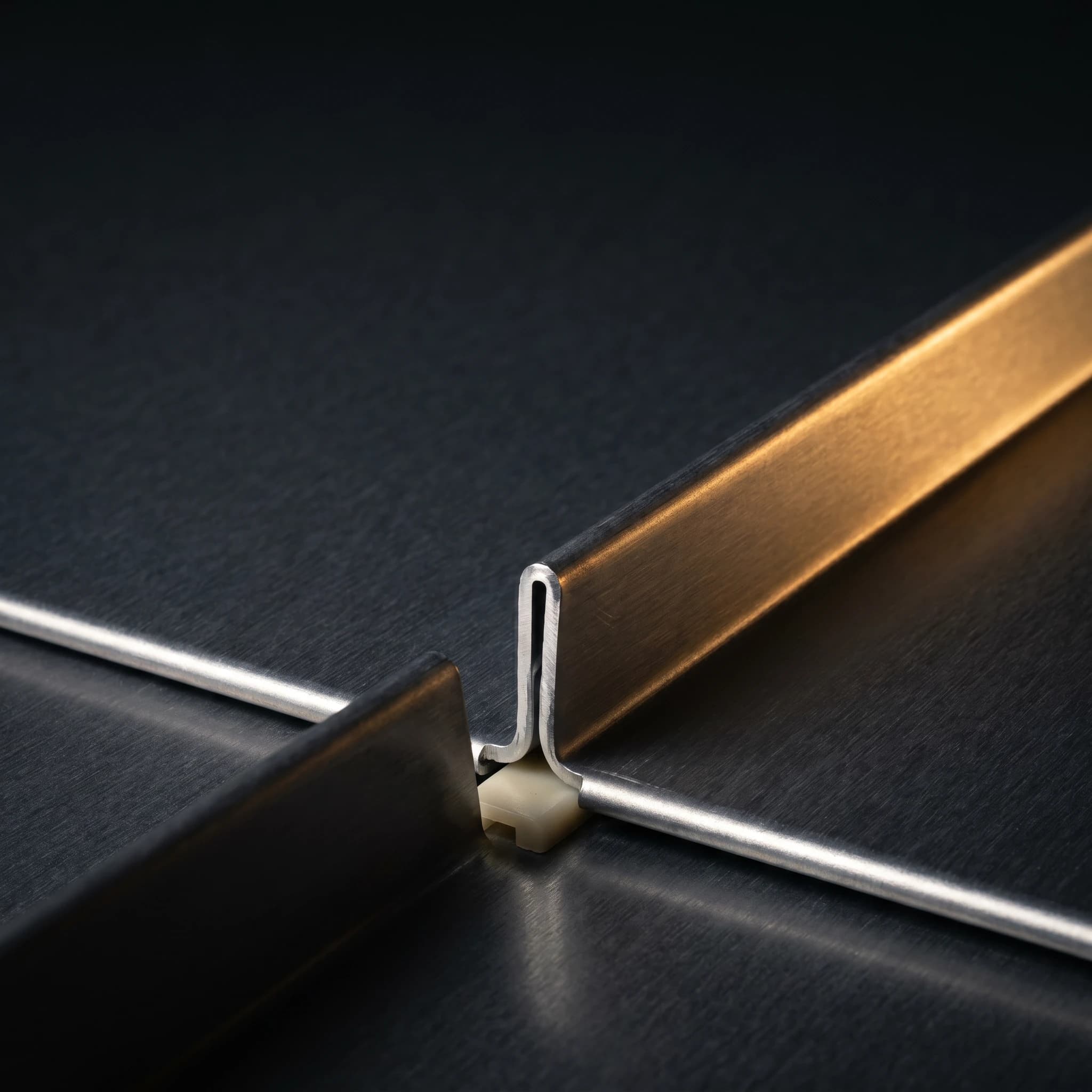
Adjacent sheets are joined through a plastic clip that is fixed to the purlin and grips the folded edges of two sheets. The clip performs three functions at once: it holds the sheet, acts as a thermal break between the metal and the bearing structure, and allows the roof to expand and contract freely along its length. Because the metal itself is never perforated by any screw, nail or rivet, the roofing blanket remains absolutely watertight across the entire surface.
A drainage channel integrated into the lock geometry diverts water even under strong head-on wind — eliminating the primary failure mode of conventional standing-seam roofs under heavy snowfall and downpour. Installation is carried out by hand: the installer steps on the joint and snaps the lock closed. No specialised tooling, seaming machine or key is required.
Why Riverclack is suited to the Russian climate
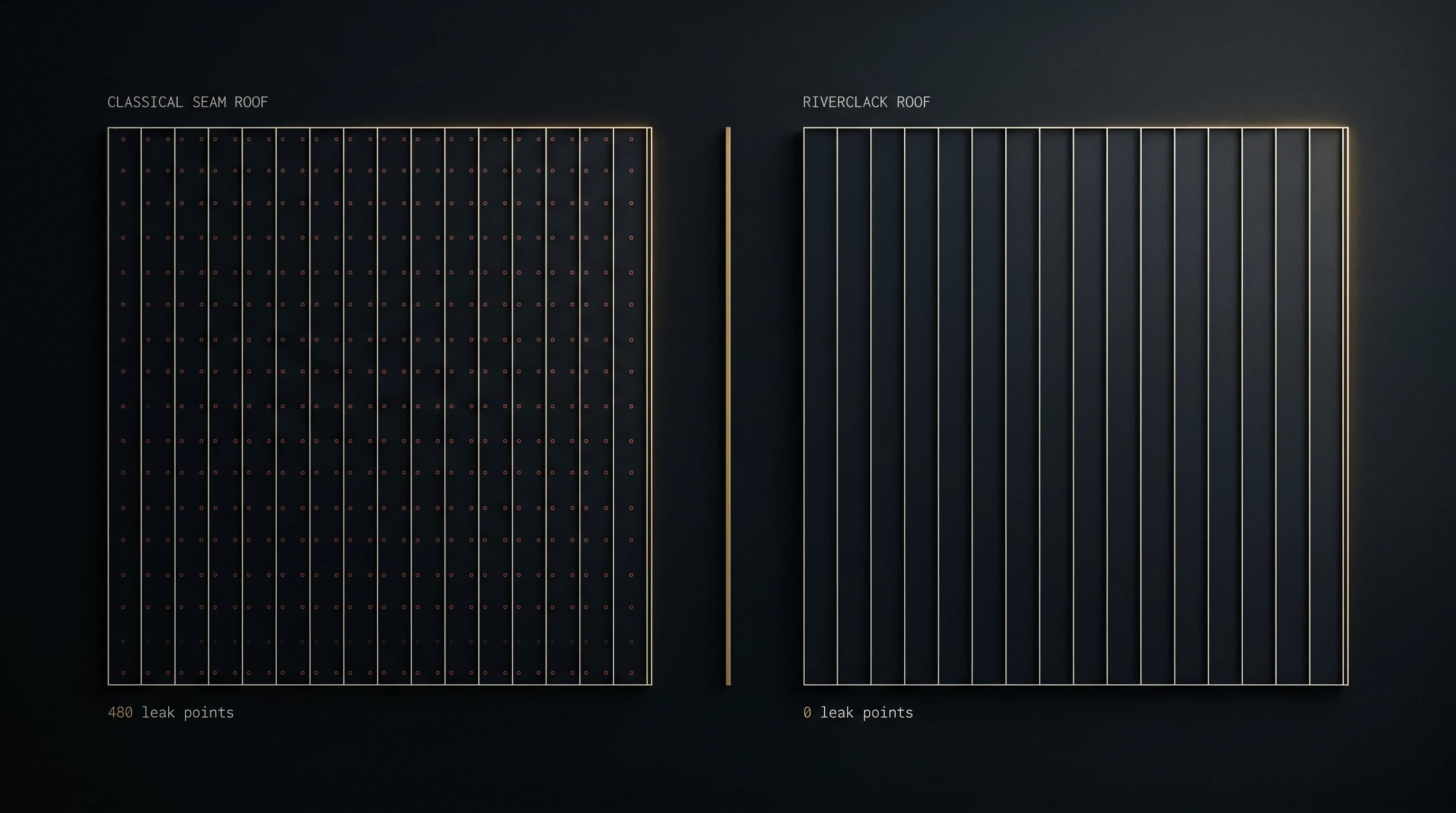
Conventional standing-seam roofs fail at two points: through-fasteners exposed to a thermal gradient and uneven thermal expansion between the sheet and the support. In a climate that swings from −40 °C in winter to +35 °C in summer, those two points become the primary cause of leaks after 5–7 years of service. The Riverclack lock removes both: sheets slide freely on the clips, and the roofing blanket has not a single perforation.
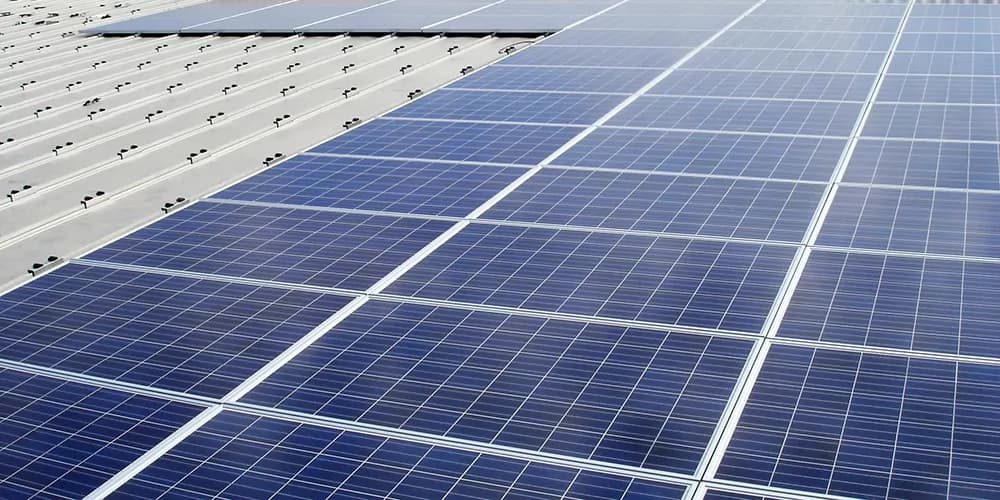
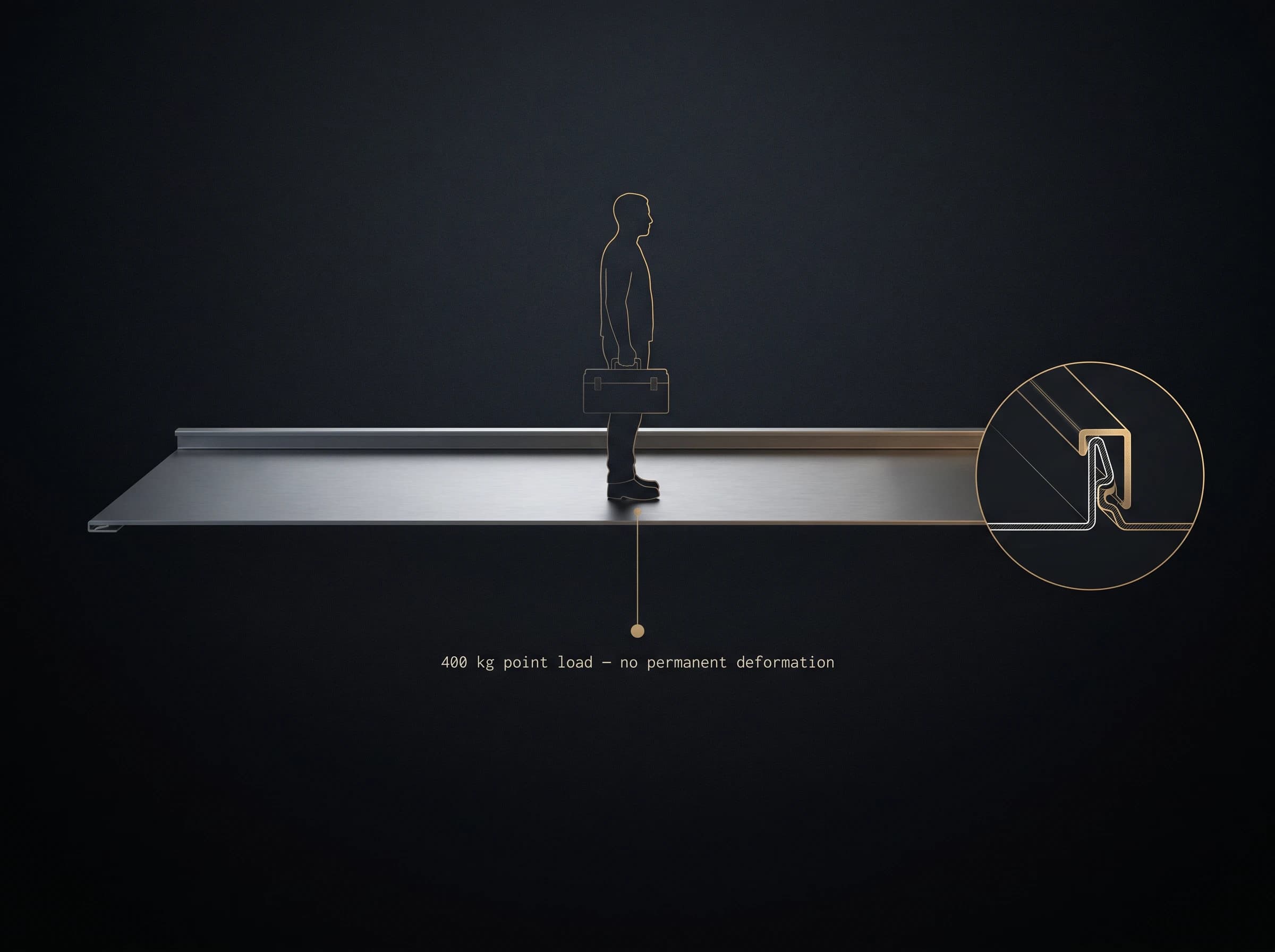
The sheet surface withstands a point load of up to 400 kg without permanent deformation — operations crews can walk the roof for HVAC, photovoltaic or snow-clearance maintenance without installing additional gangways. The EN AW 5754-H18 aluminium is not corroded by freeze-thaw cycles and is durable in the atmosphere of industrial zones.
What buildings Riverclack is used for
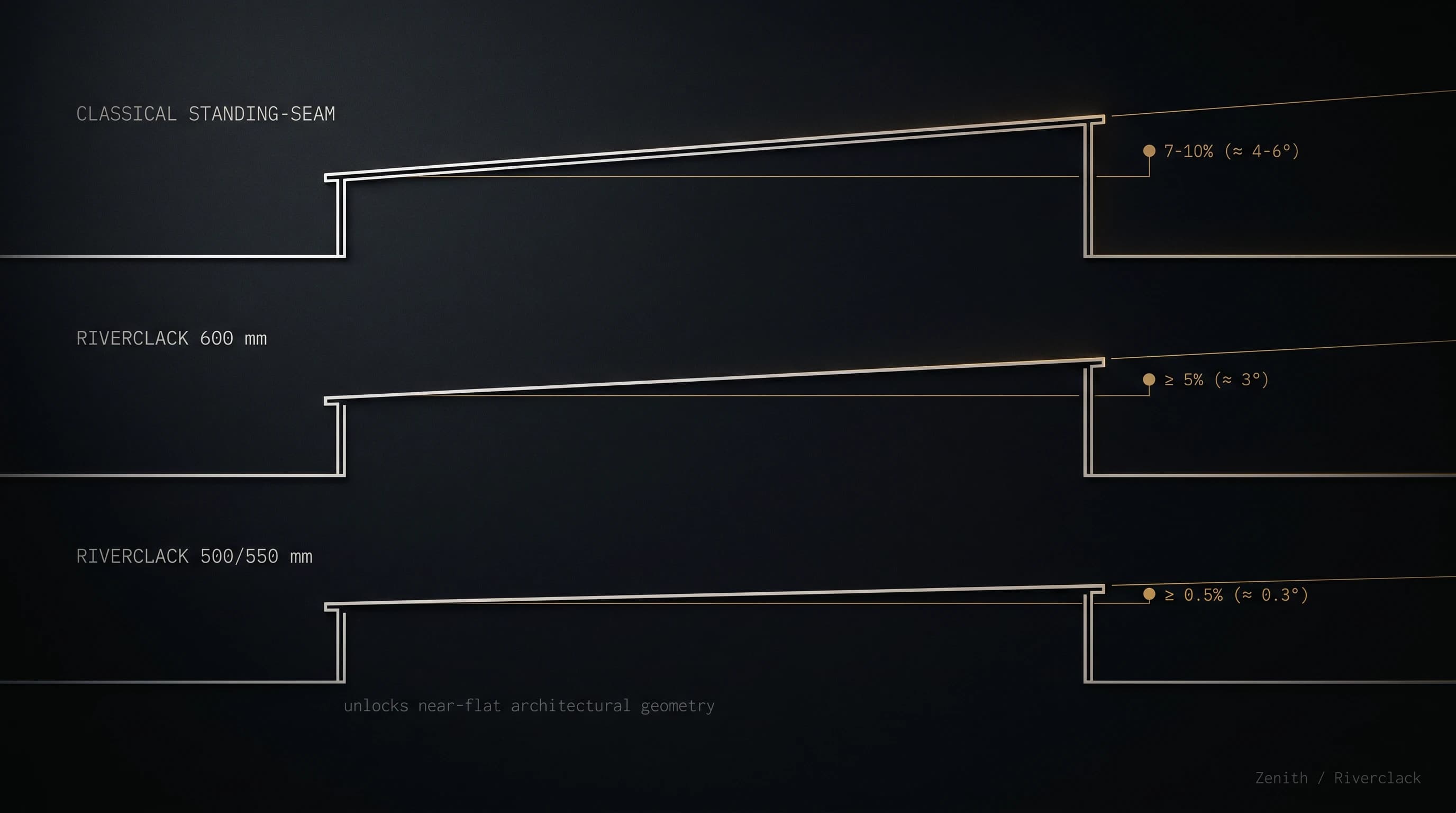
Riverclack is specified where long continuous roof spans without lateral overlaps are required: stadiums and sports venues, airports and metro stations, industrial hangars and logistics complexes, aquatic centres and indoor pools, exhibition pavilions. The minimum slope is 0.5% for 500/550 mm sheets and 5% for the 600 mm sheet — giving the architect the freedom of near-flat roofs where a conventional standing-seam system would demand at least 7–10%.
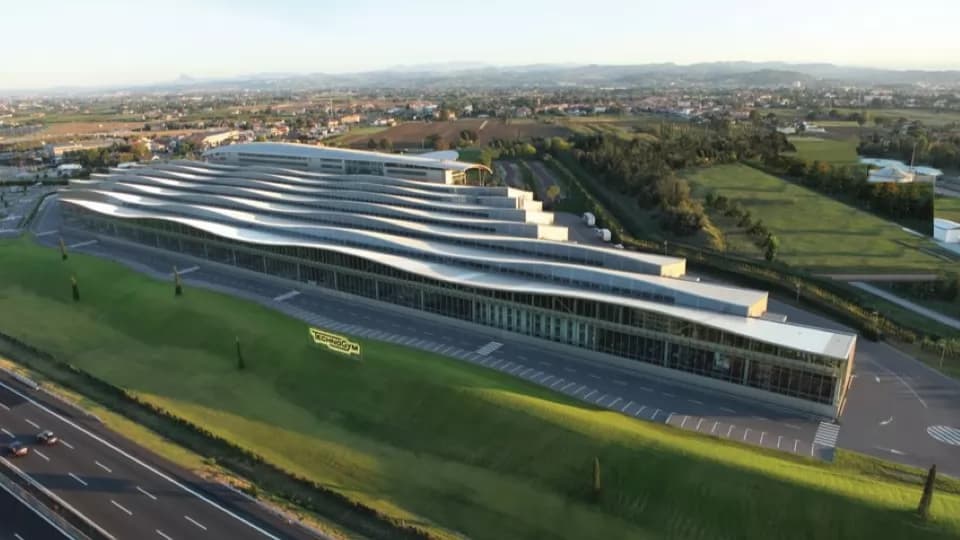
Reference projects from the manufacturer include the Irina Viner-Usmanova Rhythmic Gymnastics Palace (Moscow), Adnan Menderes Airport (Izmir), Houari Boumediene Airport (Algiers), King Saud Stadium (Riyadh), the Amex Community Stadium (UK), El Dorado Airport (Bogotá), the Don João II metro station (Lisbon) and the Technogym Village (Italy).
How Riverclack differs from a classical standing-seam roof
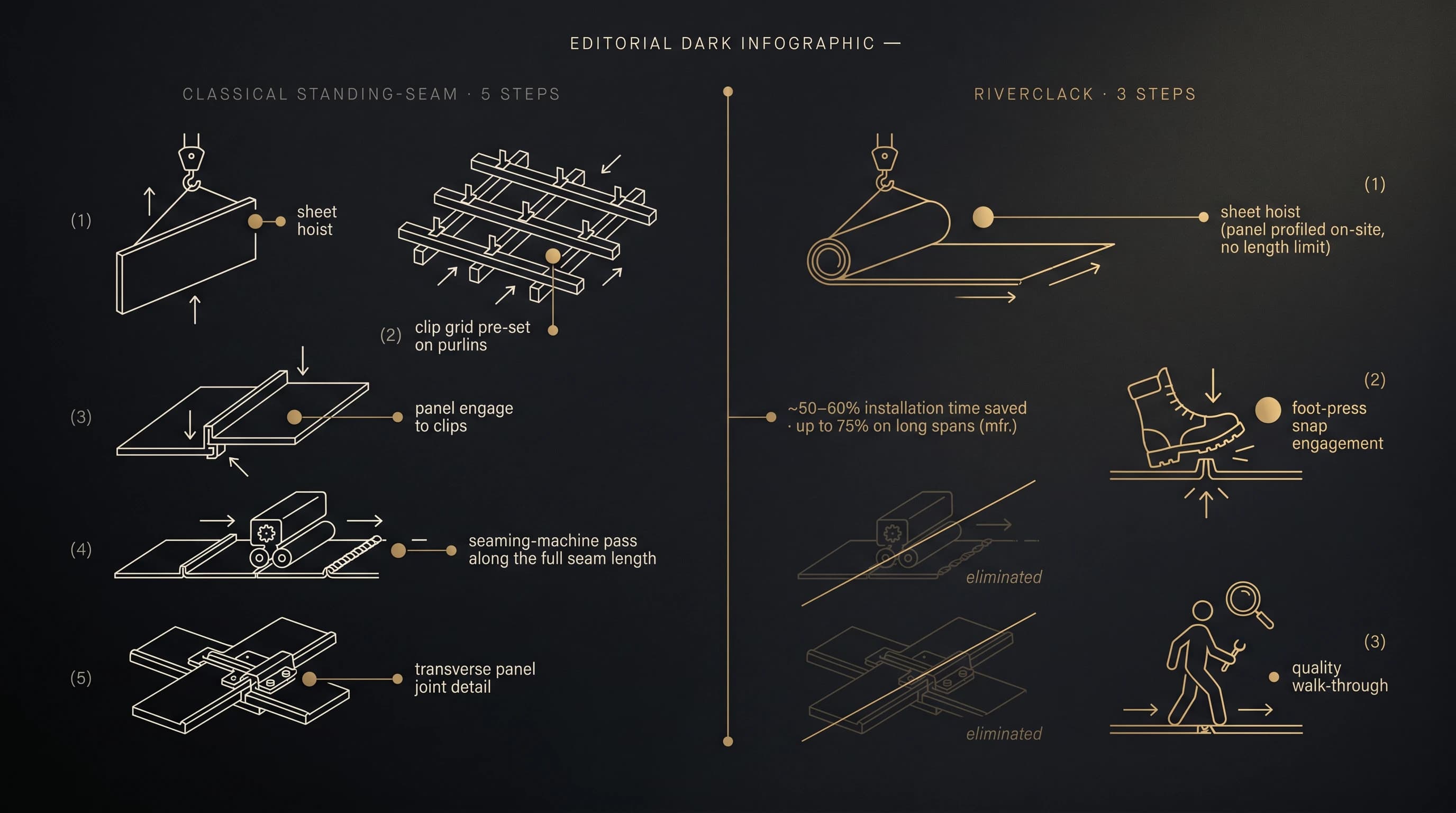
A classical standing seam requires the joint to be rolled on site using a seaming machine, and the sheet to be fixed to the substructure with a through-screw at the rib — every such fixing remains a potential leak. Riverclack eliminates both steps: the lock snaps closed with the installer's foot, and the fastener is hidden under the clip without ever crossing the plane of the metal. Our calculation puts the savings at roughly 50–60% of installation time vs mechanically-seamed standing-seam — three operations disappear: the seaming-machine pass, the pre-set clip grid, and the transverse panel joint; the manufacturer cites up to 75% on long-span and complex roofs (riverclack.com).
The 0.7 mm sheet self-curves without permanent deformation at radii above 25 m — covering most gently-curved roofs directly. For tighter geometry the panel is mechanically roll-bent at the factory: down to a convex radius of 3 m and a concave radius of 8 m. Tapered sheets from 170 to 550 mm wide at the ends clad round and elliptical volumes — stadiums, pavilions, domes — without cutting and without breaking the drainage channel.
Technical Specifications
- Panel width
- 500 / 550 / 600 mm
- Sheet thickness
- 0,7 mm
- Material
- Al 5754-H18 · Cu · Zn-Ti · Steel
- Minimum slope
- 0,5% (500–550 мм) / 5% (600 мм)
- Bending radius
- R 3 m конв. · R 8 m конк.
- Point load
- 400 kg
Application Areas
- Stadiums & Arenas
- Airports & Terminals
- Metro & Transit
- Exhibition Pavilions
- Industrial Crops
- Aquatic Centres
Frequently Asked Questions
Frequently Asked Questions
What is the minimum permissible slope for a Riverclack roof?
From 0.5% for 500 and 550 mm sheets; from 5% for the 600 mm sheet. That is significantly below the standard 7–10% threshold of a classical standing-seam roof and suits projects with near-flat roof geometry.
Is Riverclack suitable for climates with heavy snow loads?
Yes. The lock geometry with its integrated drainage channel diverts water even under strong head-on wind; the EN AW 5754-H18 aluminium is resistant to freeze-thaw cycles. The sheet surface withstands a point load of up to 400 kg without permanent deformation.
Can the Riverclack roof be walked on during service?
Yes. According to the manufacturer, the roof sheet supports a point load of up to 400 kg (an adult or maintenance crew) without permanent deformation affecting system performance.
Which sheet materials are available?
The principal material is EN AW 5754-H18 aluminium 0.7 mm thick. Copper, stainless steel, zinc-titanium and polymer-coated galvanised steel are also available. Finish ranges from the manufacturer: TREND, EXCEL, FEEL, METAL, Think ZINC.
What is the minimum bending radius of the sheet?
The 0.7 mm sheet self-curves without permanent deformation at radii above 25 m. For tighter geometries the panel is mechanically roll-bent at the factory: minimum convex radius is 3 m; minimum concave radius is 8 m. Tapered sheets from 170 to 550 mm wide at the ends are produced to clad round, elliptical and dome forms without cutting.
Where can I source Riverclack in Russia?
Terra-Zenith is the authorised Riverclack SpA dealer in the Russian Federation. Project proposals, bill-of-quantities estimates and factory logistics are coordinated from the Moscow office: terra-zenith.ru/en/contact.
Riverclack SpA
Riverclack SpA is an Italian manufacturer of metal standing-seam roofing systems, founded in 1987 and headquartered in Italy. According to the manufacturer, more than 18.4 million square metres of roofing have been installed with this technology across 35+ countries. Terra-Zenith is the authorised Riverclack dealer in Russia: detail design, supply and installation supervision. terra-zenith.ru
Related Products