Systems · Riverclack
Riverclack Green Roof
A trafficable metal roof for planting — load-bearing layer, drainage and water-tightness in one integrated system.
Introduction
A trafficable metal roof for planting — load-bearing layer, drainage and water-tightness in one integrated system.
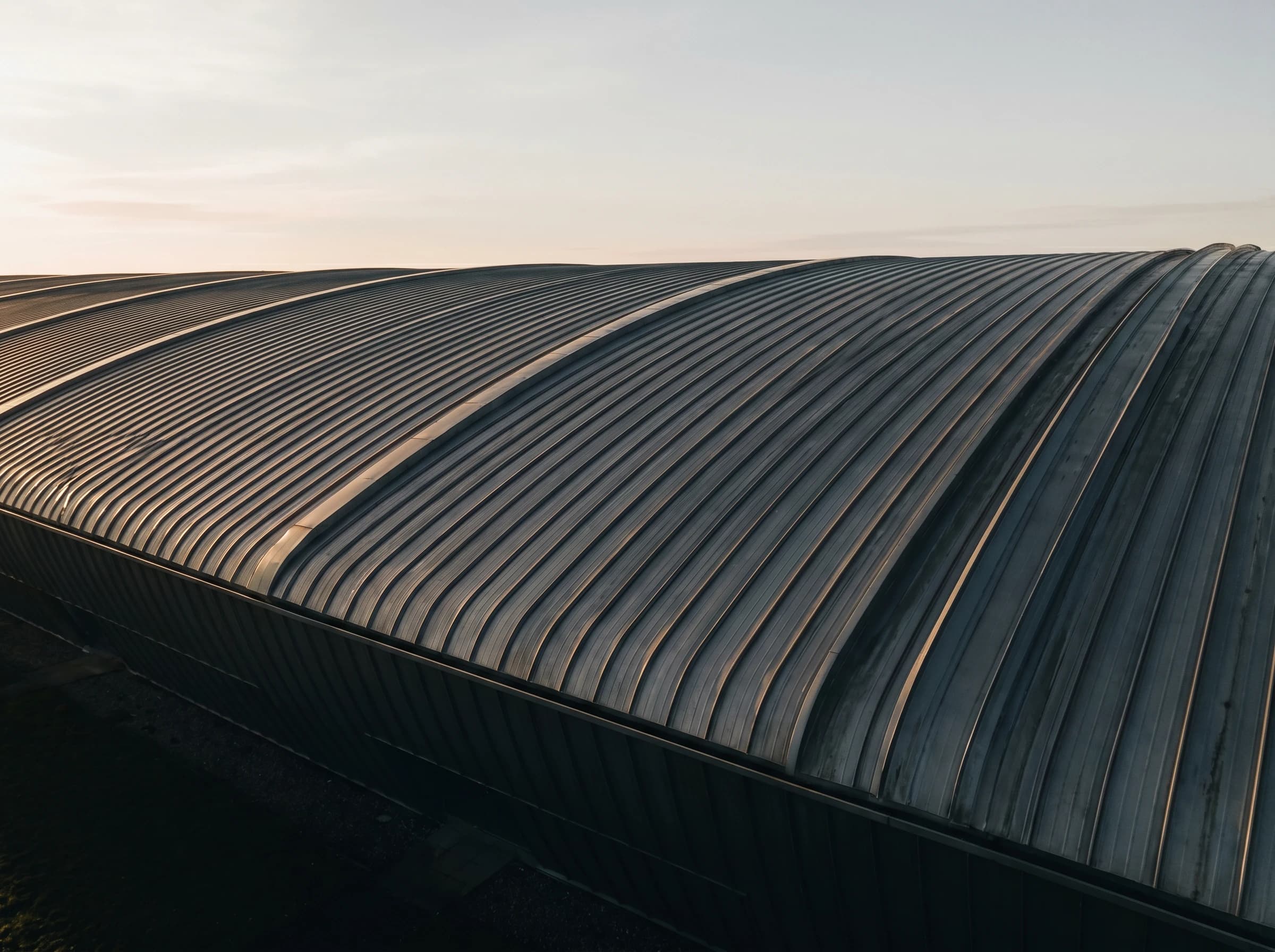
he Riverclack green roof is an integrated system in which the standing-seam metal roof blanket serves as the load-bearing and waterproofing layer beneath the planting build-up. The fundamental difference from a classical green roof on a reinforced-concrete slab: water-tightness is provided by the roof metal itself, with no separate PVC or TPO membrane. That removes the primary risk of a green roof — damage to the membrane by plant roots or garden tools during service.
The solution is intended for public buildings, business centres, hotels and mixed-use complexes in the major Russian cities — Moscow, Saint Petersburg, Kazan, Krasnodar, Sochi — where the architectural concept calls for a landscaped roof terrace and building regulations encourage the reduction of solar-absorbing surfaces. Terra-Zenith is the authorised Riverclack dealer in Russia: system design accounting for the climatic zone and installation supervision.
Why a trafficable green roof matters
A green roof solves three problems at once. Architectural: it gives the building a landscaped terrace, garden area or winter garden on what would otherwise be unused space. Climatic: it reduces the building's summer thermal load, retains rainfall and dampens the urban heat-island effect. Ecological: it returns a green surface to the city equivalent to the building footprint. In major Russian cities these three factors are increasingly written into the architectural brief at concept stage.
The fundamental problem with a classical green roof is the reliability of the waterproofing over a 30–50 year horizon. Polymer membranes lose elasticity over time, roots can penetrate the joint and replacing the membrane under soil and planting is an extraordinarily expensive operation. Riverclack removes that problem: water-tightness is delivered by metal, roots cannot break the lock, and any repair is local.
Build-up: metal + drainage + growing medium
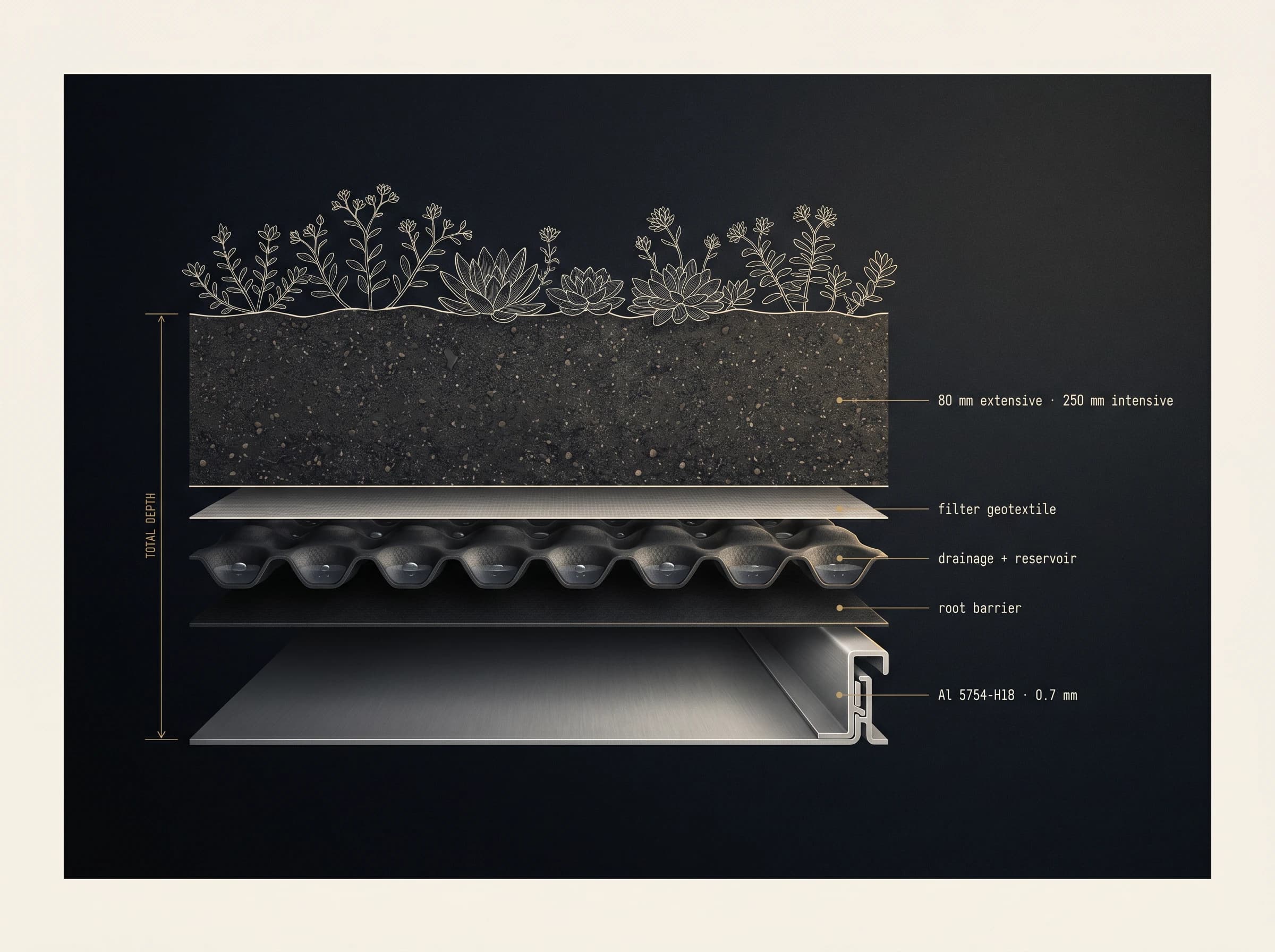
At the base is the standard Riverclack roof blanket in EN AW 5754-H18 aluminium 0.7 mm thick with the standing-seam lock. Over the metal sit a root-barrier geotextile, a profiled drainage layer with reservoir capacity, a filter geotextile and a growing medium of at least 80 mm for extensive planting (sedum, mosses) or at least 250 mm for intensive planting (lawns, shrubs, ornamental trees).
The roof sheet surface withstands a point load of up to 400 kg, and the total design load of the green roof in its water-saturated state (growing medium + drainage layer + plants) is accounted for in the substructure design. Terra-Zenith performs load calculations to SP 20.13330 at the working-drawing stage.
Suitable buildings and operation in the Russian climate
The Riverclack green roof is specified on public buildings, business centres, hotels and premium residential complexes, where the architectural concept includes a trafficable roof terrace. The minimum system slope is from 0.5% for 500/550 mm panels (from 5% for the 600 mm sheet), allowing near-flat green roofs with organised drainage.
For central and southern Russia, drought- and frost-tolerant plant palettes are selected — sedum, stonecrop, sage, thyme for extensive planting; lawn mixes and winter-hardy shrubs for intensive. The drainage layer is sized for the snow load and spring flood discharge of the project's specific climatic zone.
Technical Specifications
- Panel width
- 500 / 550 / 600 mm
- Sheet thickness
- 0,7 mm
- Material
- Al 5754-H18
- Minimum slope
- 0,5% (500–550 мм) / 5% (600 мм)
- Point load
- 400 kg
Application Areas
- Commercial Buildings
- Exhibition Pavilions
- Industrial Crops
Frequently Asked Questions
Frequently Asked Questions
Will the metal base support the load of the green build-up?
Yes. The base Riverclack roof sheet supports a point load of up to 400 kg. The total distributed load of water-saturated growing medium with planting is accounted for in the substructure design at the working-drawing stage.
How is water-tightness assured without a membrane?
Water-tightness is provided by the metal roof blanket itself with its standing-seam lock — no perforations, no through-fasteners, with an integrated drainage channel. That removes the primary risk of a green roof: damage to the membrane by roots or tools.
Is the system suitable for Moscow and central Russia?
Yes. The EN AW 5754-H18 aluminium is resistant to freeze-thaw cycles; the plant palette and the depth of growing medium are selected for the climatic zone per SP 131.13330. Drainage is sized for snow load and spring flood discharge.
What is the minimum required slope?
From 0.5% — the same minimum slope as the base Riverclack 500/550 mm roof. The slope guarantees drainage through the seam channel regardless of the state of the growing medium.
Which types of planting are possible?
Extensive (sedum, mosses, stonecrop) at a growing-medium depth from 80 mm with minimal maintenance; intensive (lawns, shrubs, ornamental trees) from 250 mm with regular maintenance. The specific palette is selected by the landscape architect.
Riverclack SpA
Riverclack SpA is an Italian manufacturer of metal standing-seam roofing systems for classical, photovoltaic and trafficable green roofs, founded in 1987. Terra-Zenith is the authorised Riverclack dealer in Russia: integrated system design, load calculations to SP 20.13330 and installation supervision. terra-zenith.ru
Related Products