Systems · Riverclack
Riverclack Facade
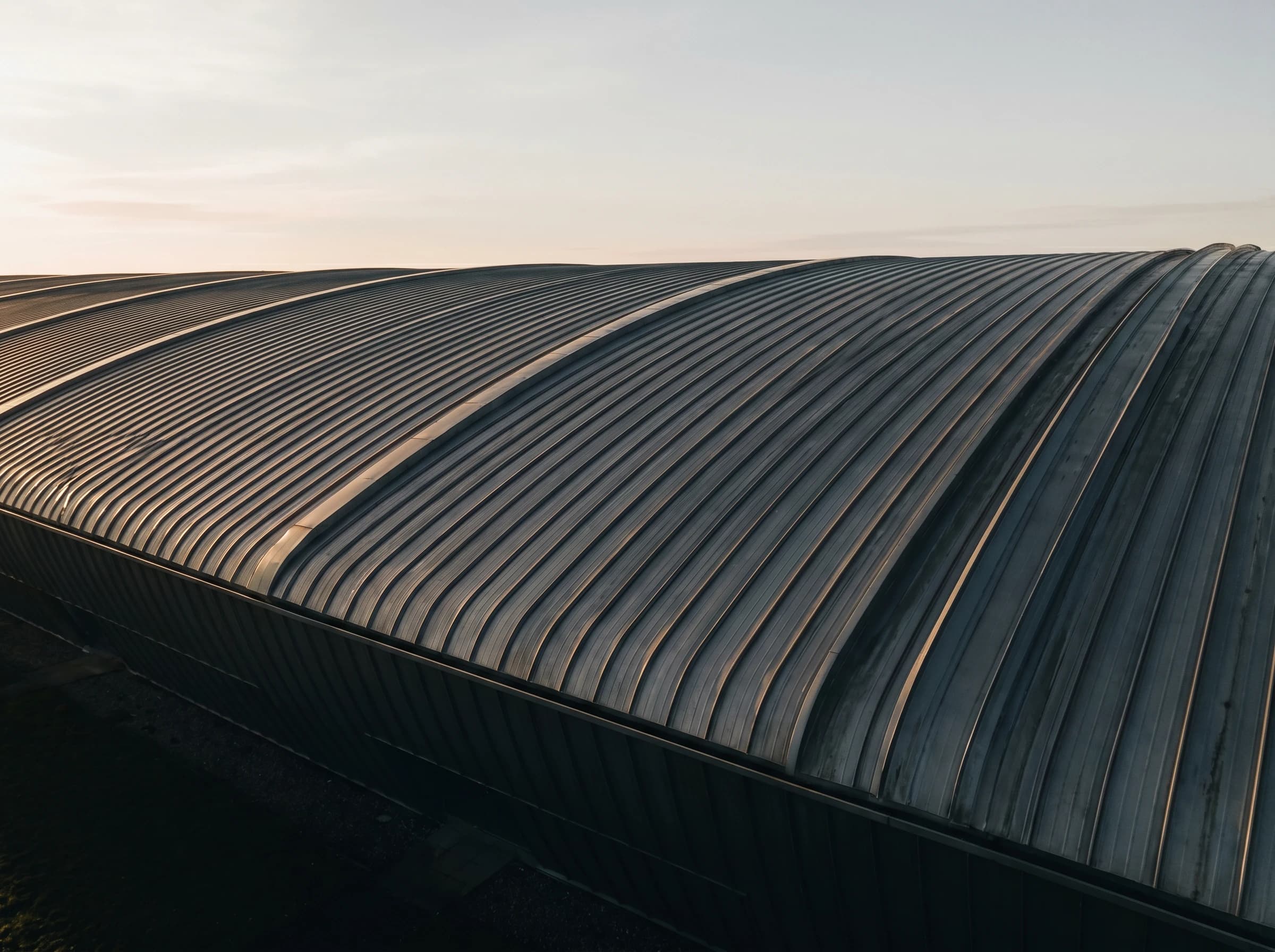
A facade built on the same patented lock geometry — a single visual plane from roof to wall, with no visible fasteners.
Introduction
A facade built on the same patented lock geometry — a single visual plane from roof to wall, with no visible fasteners.
he Riverclack facade system carries the same patented standing-seam geometry as the roofing line — applied in a vertical or inclined plane. This lets the architect shape a continuous metal building envelope in which roof and wall transition into one another visually and technically, with no break in the fastening detail, no exposed joints and no visible screws. The result is contemporary architecture for industrial buildings, sports arenas, exhibition pavilions and public buildings clad in a single metal envelope.
Available materials include EN AW 5754-H18 aluminium, copper, stainless steel, zinc-titanium and powder-coated galvanised steel. Finish options include embossing, pre-weathered zinc, patinated copper and anodised aluminium. Terra-Zenith is the authorised Riverclack dealer in Russia: material and finish selection to the architectural concept, detailing of the roof-to-facade transition and installation supervision.
When the Riverclack facade is specified
The Riverclack facade is a solution for projects whose architectural concept calls for a continuous metal envelope: public buildings, museums and exhibition centres, sports arenas and stadiums, Class A office buildings, industrial and logistics facilities with architectural ambition. The system is particularly effective where roof and facade resolve into a single line with no visible detail — on curved pavilions, for instance, or on buildings with under-roof cornices.
Concealed fixing means the facade reads as a monolithic metal plane, with no vertical runs of screws or rivets that over time leave corrosion traces. That matters especially for copper and zinc-titanium cladding, where patination must develop evenly across the surface.
Curved facades and integrated architecture
The 0.7 mm sheet self-curves without permanent deformation at radii above 25 m — gentle curved facades are achieved by the alloy alone. For tighter geometry the panel is mechanically roll-bent at the factory: down to a convex radius of 3 m and a concave radius of 8 m. This gives the architect the freedom to design curved facades — rounded corner volumes, elliptical towers, wave-form walls — without complex cutting and without point-by-point mechanical finishing. Tapered sheets from 170 to 550 mm wide at the ends clad cone and dome forms as a single surface.
The transition between roof and facade is resolved as a single continuous line of metal. At the curved transition there is neither an interrupting flashing strip nor a lap apron: the sheet continues from the horizontal plane to the vertical plane through a single bending radius. This is a unique architectural capability that no classical standing-seam system can offer.
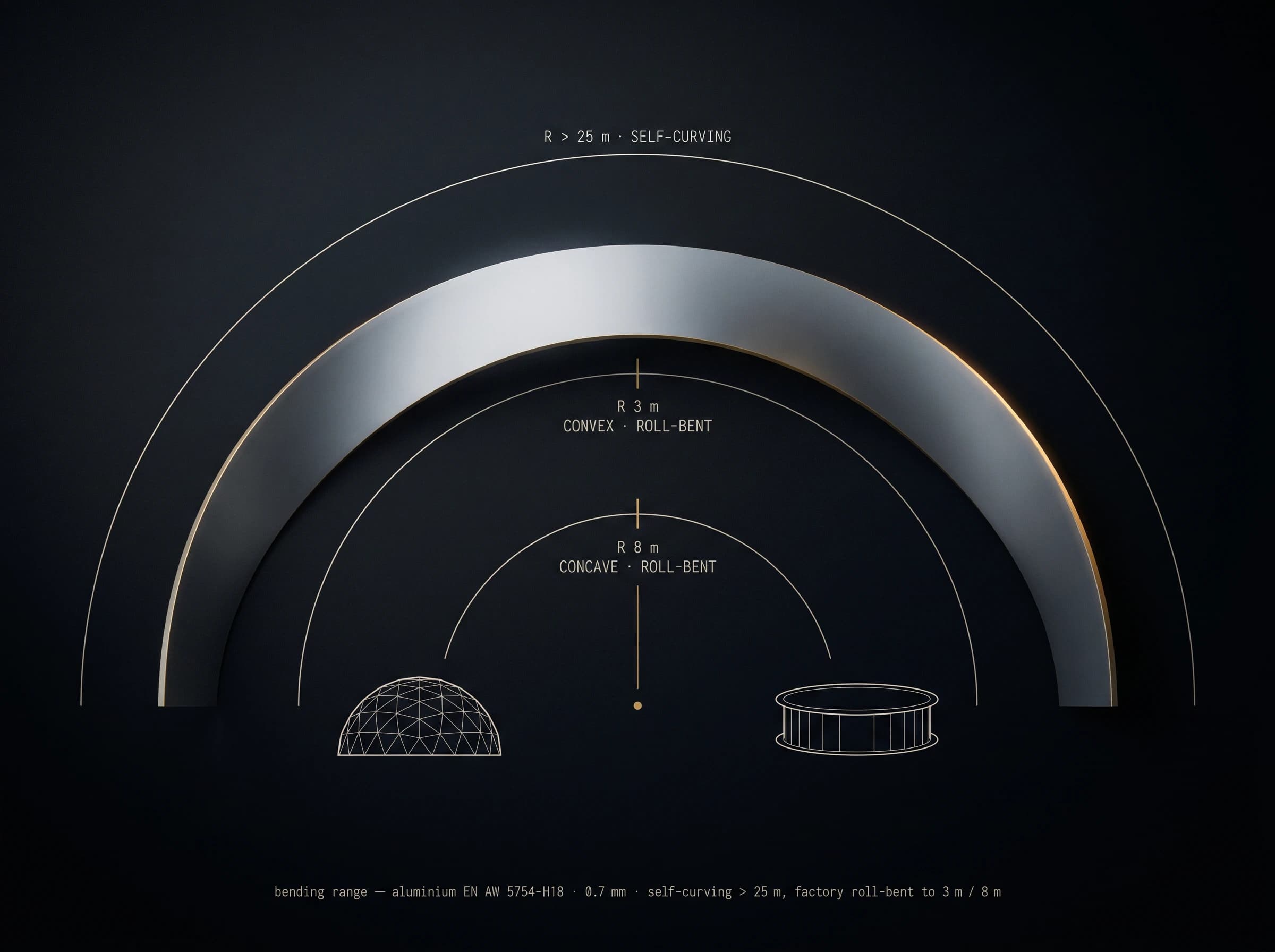
Available materials and finishes
EN AW 5754-H18 aluminium is the principal material; available in the TREND, EXCEL, FEEL ranges and in anodised variants. Copper — natural or pre-patinated — gives the facade a living surface that evolves over time. Zinc-titanium in the Think ZINC line is supplied factory pre-weathered, eliminating the risk of uneven darkening in the first season of service. Stainless steel and polymer-coated galvanised steel cover industrial and budget-led projects.
The METAL line includes finishes with a high Solar Reflective Index (SRI) — reducing thermal load on the building in southern regions of Russia (Krasnodar Krai, Stavropol, Rostov Oblast) and helping satisfy energy-efficiency requirements on industrial sites.
Technical Specifications
- Panel width
- 500 / 550 / 600 mm
- Sheet thickness
- 0,7 mm
- Material
- Al 5754-H18 · Cu · Zn-Ti · Steel
- Bending radius
- R 3 m конв. · R 8 m конк.
Application Areas
- Stadiums & Arenas
- Airports & Terminals
- Exhibition Pavilions
- Commercial Buildings
- Industrial Crops
Frequently Asked Questions
Frequently Asked Questions
Can one Riverclack system be used for both roof and facade?
Yes. The lock geometry is identical in both versions, which allows the roof-to-facade transition to be resolved as a single continuous line of metal — with no transition detail and no flashing. This is a unique capability of the Riverclack system.
What is the minimum facade curvature radius?
Minimum convex radius is 3 m; minimum concave radius is 8 m. Tapered sheets from 170 to 550 mm wide at the ends clad cone and dome forms without cutting.
Which finishes are available?
Embossing, pre-weathered zinc (Think ZINC), patinated copper, anodised aluminium, and the TREND, EXCEL, FEEL and METAL ranges — including high-SRI finishes for southern regions.
Is the system suitable for high-rise buildings?
Yes. The concealed fixing withstands wind loads of the corresponding high-rise class; the plastic clip allows free thermal expansion of the sheet along its length. Terra-Zenith performs the wind- and snow-load calculations to SP 20.13330.
Are the fasteners visible on the finished facade?
No. The Riverclack lock is a concealed-fixing system: the plastic clip is fully hidden beneath the folded edges of two adjacent sheets. There is not a single visible screw, rivet or flashing strip on the facade surface.
Riverclack SpA
Riverclack SpA is an Italian manufacturer of metal standing-seam systems for roofs and facades, founded in 1987. Terra-Zenith is the authorised Riverclack dealer in Russia: material and finish selection, detailing of transitions and installation supervision. terra-zenith.ru
Related Products