
Stavropol Krai
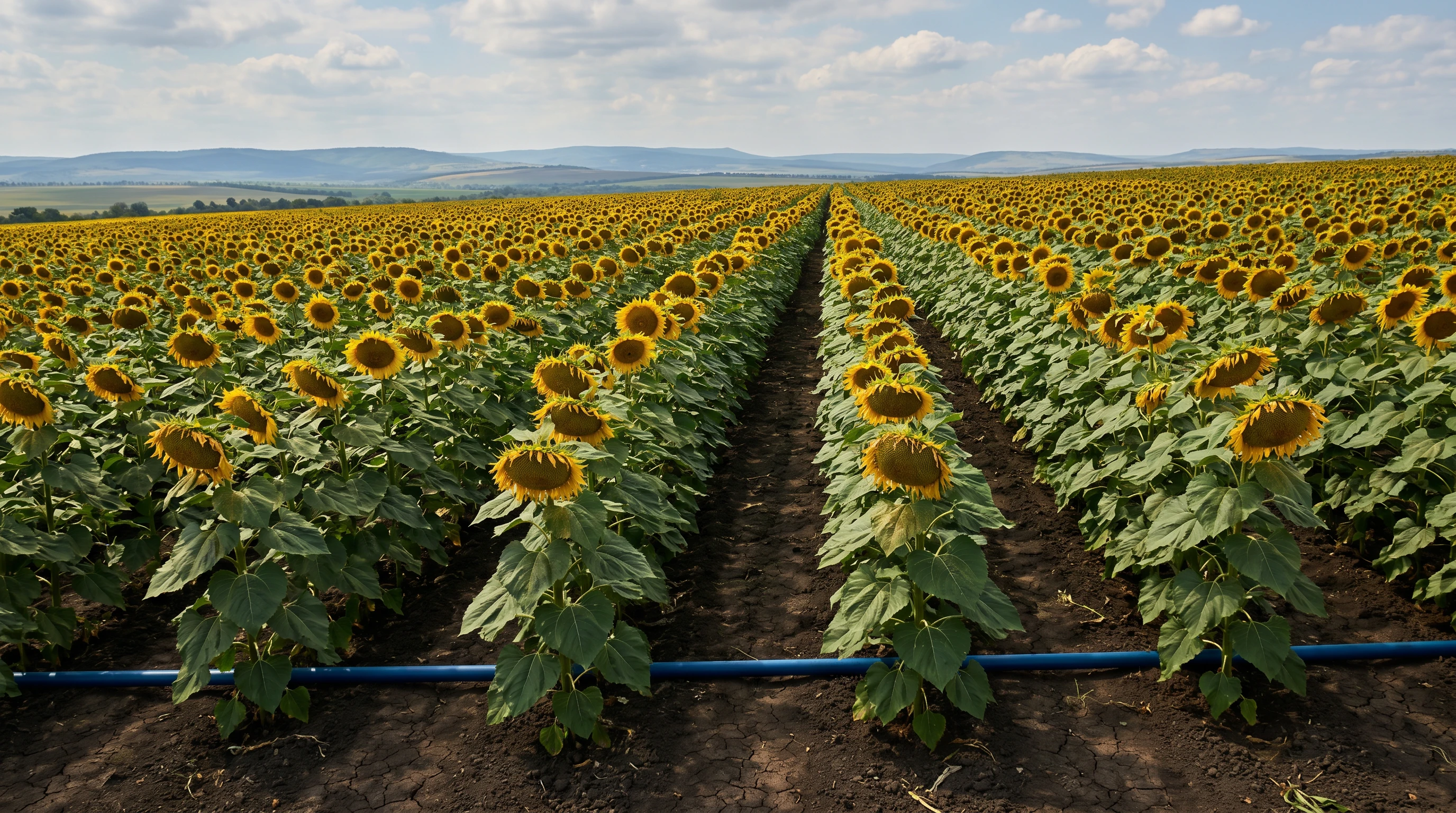
Stavropol Krai — subsurface drip irrigation for oilseed and grain.
Stavropol Krai is Russia's largest sunflower producer and second-largest winter-wheat producer. 5.7 million hectares of farmland, 75% of the krai's territory, mostly chestnut and dark-chestnut soils of the steppe zone. A breadbasket operating on the thin edge between classical rainfed agriculture and the proven drying of the last decade.
April–June precipitation dropped 28–32% versus the prior 30-year baseline — the sharpest decline anywhere in the Southern Federal District. The dry scenario is the norm, not the exception. Subsurface drip irrigation is no longer a "nice upgrade" here, it is a strategic yield-stabilisation instrument. Terra-Zenith designs and installs systems for krai agroholdings — from Mineralovodsky in the west to the eastern steppes of Neftekumsky.
Stavropol climate and soils — what matters for design
Stavropol is the transition zone between northern forest-steppe and the Caspian semi-desert. Mean annual temperature +9.5 to +10.5 °C, active-temperature sum 3,000–3,400 °C·days. Summer is dry and hot: July–August mean +24…+28 °C, peaks +38–40 °C at low humidity (15–25%). Winters are moderate: January −4…−7 °C, absolute minimum −30…−35 °C once every 5–8 years.
Soils: chestnut (40%), dark-chestnut (28%), ordinary chernozem (18%) in the west, light-chestnut and solonetz in the east. Humus horizon 30–80 cm — shallower than Kuban, smaller natural reservoir. A dry June without irrigation leaves wheat and sunflower without water in the critical fill window.
Frost line on chestnut soils 70–90 cm, deeper than standard GEOFLOW burial (25–40 cm). Winter routine — drainage through LIN auto-valves before sustained sub-zero (mid-to-late November). GEOFLOW PE is validated to −35 °C freeze-thaw cycles, covering the Stavropol absolute minimum.
Sunflower — the krai's primary crop
Stavropol is the world's most intensive sunflower production zone: up to 1.2 million ha under the crop, 25–35% already irrigated by some mechanism. Rainfed average 1.8–2.4 t/ha with high weather-driven variability (drought 2020 — 1.4 t/ha, wet 2018 — 2.9 t/ha). With subsurface drip, yield stabilises at 3.2–3.6 t/ha regardless of weather, oil content rises from 47–49% to 51–53%.
Design parameters for Stavropol sunflower: depth 25–35 cm, lateral 70–100 cm (one tape per 2 rows at 70 cm row spacing), emitter 30–50 cm, flow 1.0–1.6 L/h. Seasonal norm 400–600 mm split into 8–12 events. Bulk goes in July (flowering and seed fill) and the first decade of August.
100 ha 2026 economics: investment 35–45 M₽, yield uplift +1.2–1.4 t/ha (2.0 → 3.3 t/ha), revenue uplift 4.2–5.0 M₽/year at 35,000 ₽/t. Payback 7–9 years without subsidy, 5–7 years with reclamation state support.
Winter wheat — rotation stabiliser
Stavropol produces 8–10% of Russia's wheat — about 8 M tonnes per year at 4.2–4.6 t/ha rainfed average. Notable: high gluten (24–28%, traditionally class 2 and 3) drives export-market price premium. With subsurface, yield rises to 6.5–7.5 t/ha at stable 26–28% gluten.
Design parameters are standard wheat (depth 20–30 cm, lateral 30–45 cm, flow 1.0–1.6 L/h) — see /blog/winter-wheat-yield-deep-dive for full economics. Stavropol's specific need: late-autumn supplementation in November–December if autumn rains miss 80 mm. Subsurface lets you add 30–50 mm in late autumn, critical for entering winter with a strong tiller count.
Rapeseed and corn — diversification
Stavropol agroholdings now diversify into rapeseed (as a grain rotation predecessor) and grain corn (feeding regional livestock growth). Both crops respond exceptionally well to drip irrigation here.
**Rapeseed** — depth 20–30 cm, lateral 45–60 cm, seasonal 400–600 mm. Subsurface raises oil content from 42–44% to 46–48% and stabilises yield at 3.5–4.5 t/ha (rainfed 2.0–2.8). Rapeseed is most water-demanding at budding — which exactly coincides with the Stavropol May drought peak.
**Grain corn** — depth 25–35 cm, lateral 70–90 cm, flow 1.0–1.6 L/h. Seasonal 500–800 mm. Subsurface stabilises grain yield at 8–10 t/ha (rainfed 4–6 t/ha), plus reduces aflatoxin risk (low grain moisture at cool nights blocks fungal development).
Logistics and support
Terra-Zenith serves Stavropol Krai with a regional presence in the Mineralovodsky district. Standard delivery 7–14 days from stock, emergency component swap within 48 hours. Winter service (surface component removal, drain-valve checks, pressure-gauge testing before spring start-up) is included in service contracts for 50+ ha projects.
Stavropol-specific consideration — dust storm risk in April–May. For eastern-steppe projects (Neftekumsky, Levokumsky, Arzgirsky) Terra-Zenith additionally designs reinforced filtration (sand + disk combination) and more frequent auto-backwash. Costs more upfront, pays back within one season.
Key crops
Stable water supply through seed fill — higher oil content and 1000-seed weight across Stavropol, Rostov and Voronezh regions.
Early-spring moisture without waterlogging — root protection under temperature swings on southern Russian chernozems.
Stable moisture during budding — higher oil content for fields in Tatarstan and Stavropol.
Controlled root-zone feeding for high silage and grain yields.
Frequently Asked Questions
Can the system run on chestnut soils with elevated salinity?
Yes, with pre-analysis. Stavropol chestnut soils carry moderate salinity (1–3 g/L); subsurface delivery does not create a problem because water enters below the evaporation zone and does not wick salts to the surface. On solonetz fields (eastern krai) a flush regime every 3–4 years is recommended.
What about the worst drought years (2020-class)?
In extreme drought (under 150 mm Apr–Jun precip), subsurface still produces 2.8–3.0 t/ha sunflower vs 1.4 t/ha rainfed. The shift to irrigation is insurance against this year, not optimisation.
What is the investment for 100 ha sunflower in Stavropol?
Indicatively 35–45 M₽ in 2026, including GEOFLOW tape (70 cm spacing), GEOPVC DN 250 PN 12.5 main, filtration, borehole with 60 m³/h pump, and installation. Without pump station — 8–12 M₽ cheaper.
Can a system be installed on leased land?
Technically possible, economically viable only on 8–10+ year leases with renewal option. Subsurface is a 15+ year asset; short leases create asset-loss risk on owner change.
Compatible with drone herbicide applications?
Fully. Drone operates above ground, system below — no interaction. Many of our Stavropol customers use drone protection alongside subsurface irrigation — this combination is best-practice for oilseed in the krai.
Which sunflower hybrids respond best to subsurface irrigation?
All modern hybrids (Tunka, Avangard, Lascla Kladek, Pioneer series) respond positively. High-oleic varieties show the largest oil-content uplift. Confectionery varieties (large-seed) reach premium class through stable fill.
Project forecast for your Stavropol field
Describe crop, area, and current rainfed yield — we return a design solution and 10-year economic projection with subsurface within 48 hours.