
Subsurface drip irrigation: complete guide.
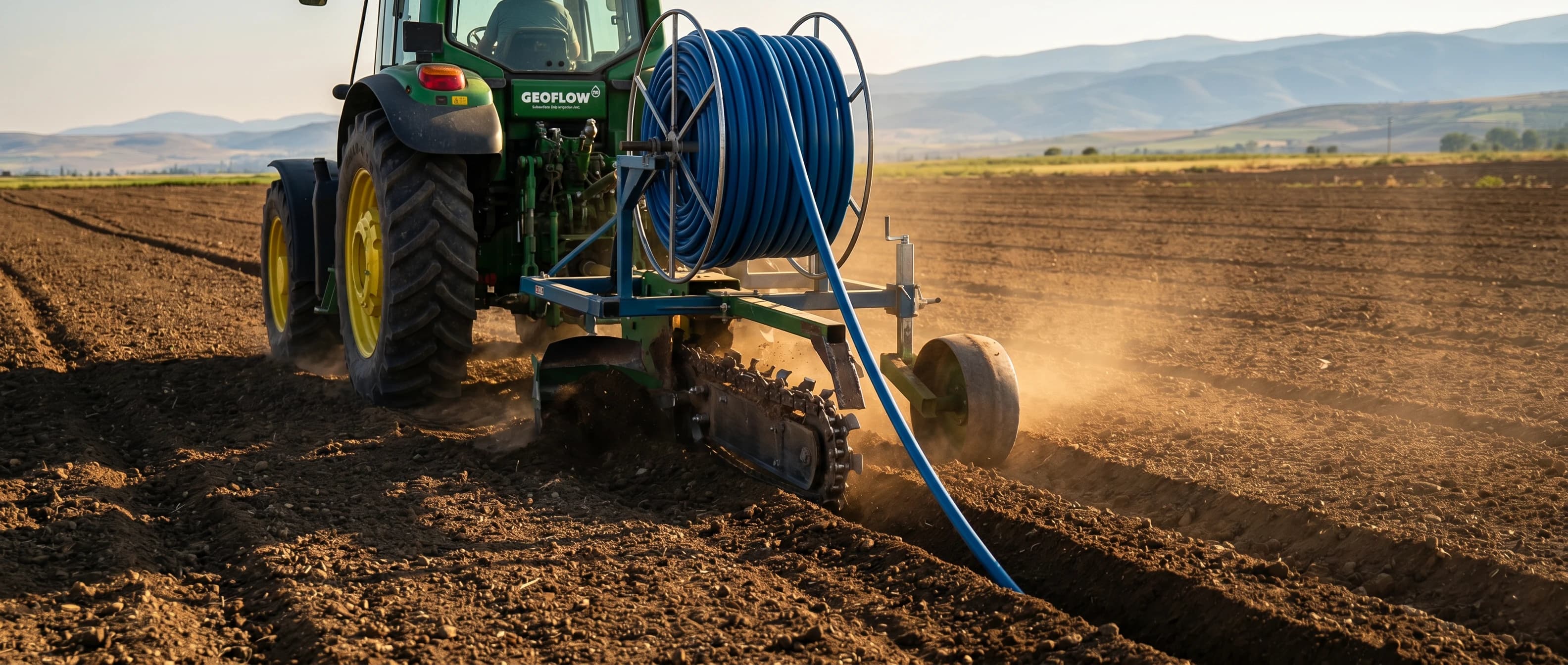
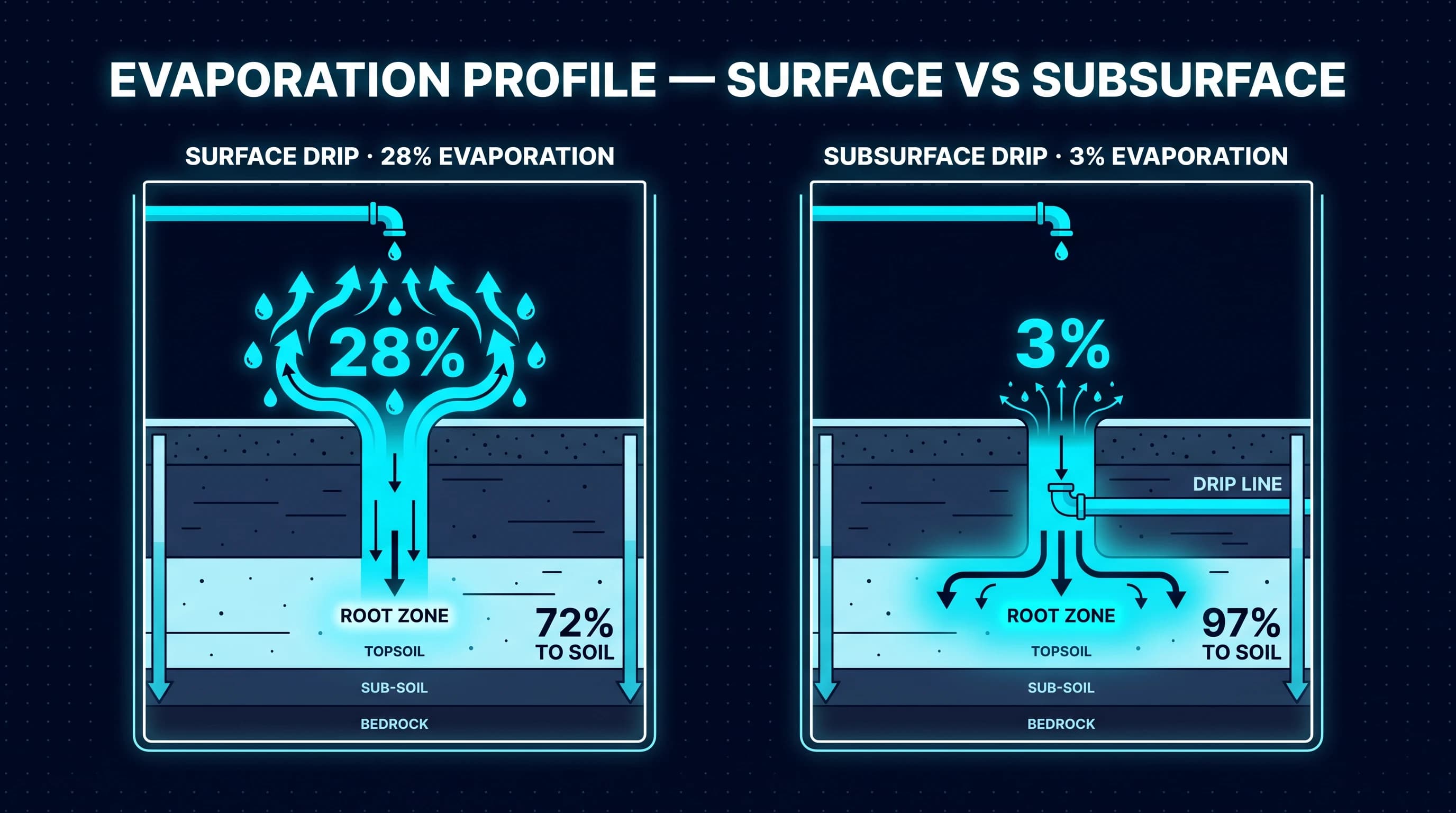
Subsurface drip irrigation is a micro-pressure irrigation method in which water and crop nutrients are delivered directly to the root zone through a buried drip line. It reduces evaporation, surface runoff, and wind-driven losses to near-zero — the same yield is achieved with 35–55% less water and 25%+ less fertilizer. Because the line stays underground, the annual lay-out and recovery labor cost of surface drip is also eliminated.
Four numbers that move on-site
Geoflow Türkiye subsurface lines, given correct design and filtration, deliver this performance repeatably for 15+ years.
How does the system work?
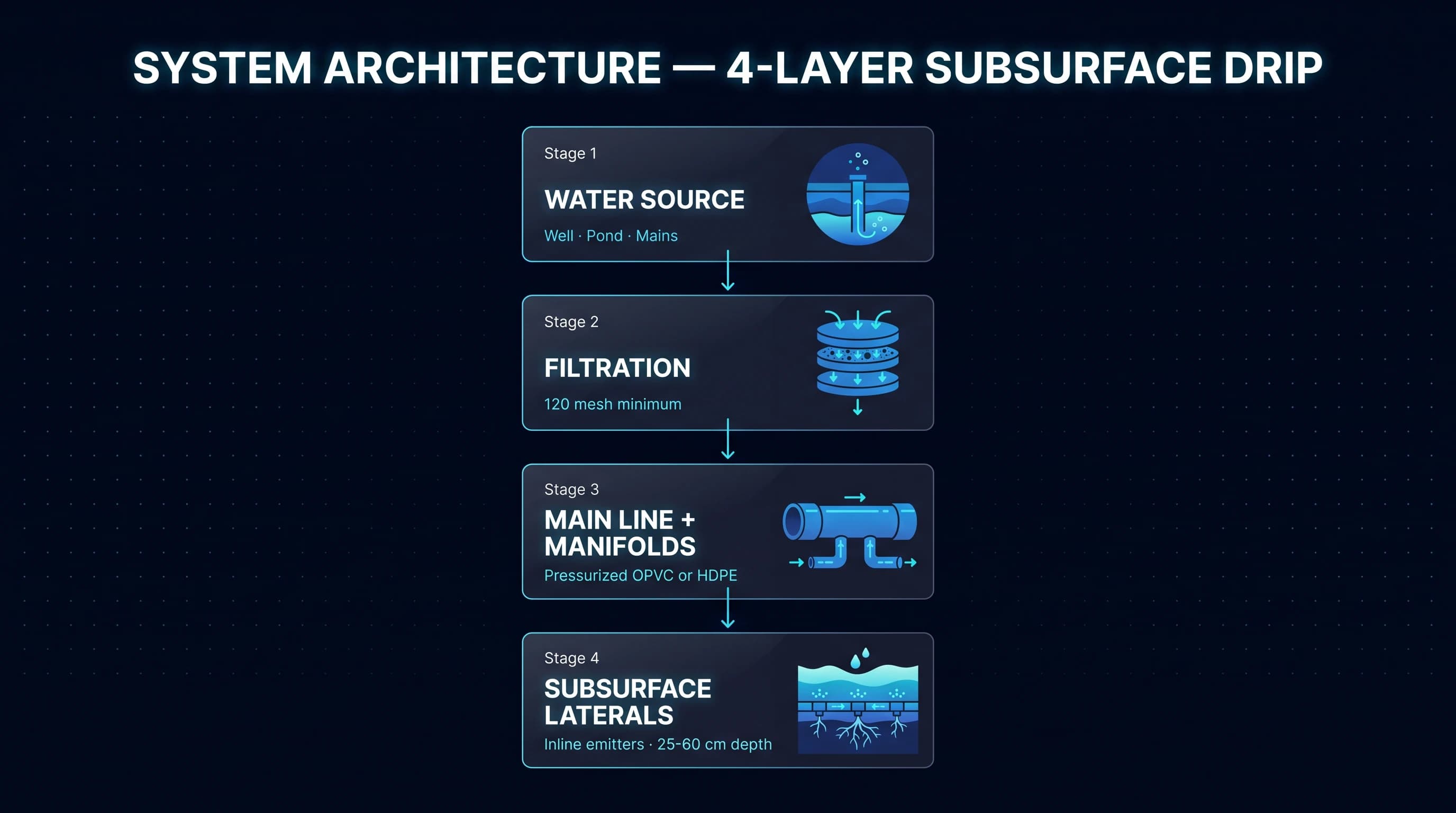
A subsurface drip system has four core layers: (1) water source (well, reservoir, lake, municipal supply, or treated-water plant), (2) filtration unit (typically disk or sand filter, 120 mesh minimum), (3) main line and sub-manifolds (typically oriented PVC or HDPE pressure pipe), (4) buried drip laterals with integrated in-line emitters.
Water flows from the main into manifolds, then into laterals. In-line emitters spaced along the lateral release at constant flow at every point, wetting the root zone. Pressure-compensating (PC) emitters ensure every emitter on long laterals and sloped fields delivers the same flow rate. The system is completed with automatic flush valves, air-release valves, and backflow preventers.
Subsurface drip is not a product — it is an infrastructure decision. With correct design 15+ years of service, with the right line 10 years of root-intrusion warranty — that's an investment claim.
What burial depth applies?
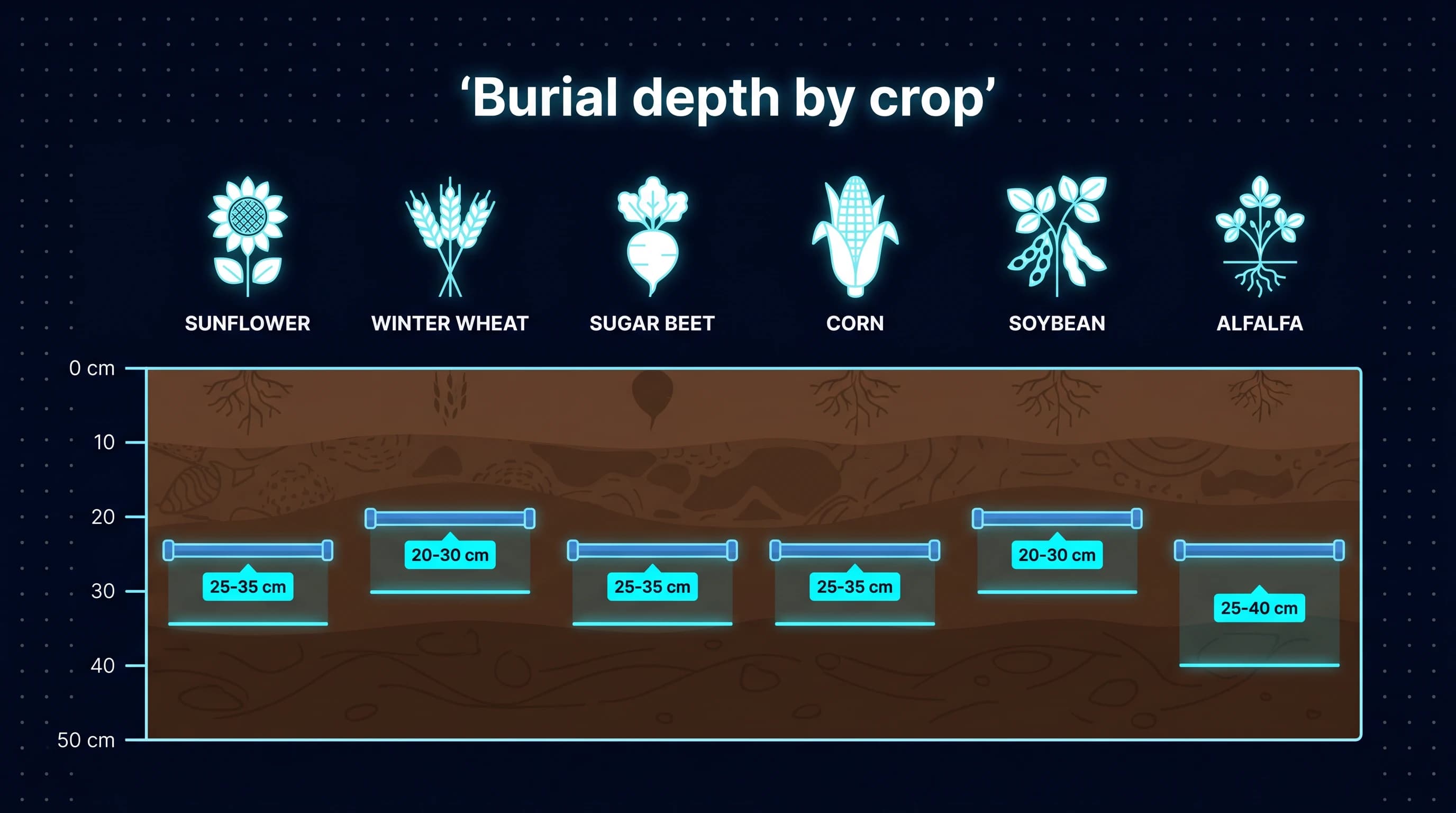
Typical burial depths: 25–35 cm for field crops (sunflower, winter wheat, corn, soybean, sugar beet, alfalfa); 35–60 cm for orchards (walnut, apple, vineyard, peach); 10–20 cm for landscape and turf. Depth selection rests on three factors: the crop's effective root depth, soil texture (shallower in sandy, deeper in clay), and surface mechanical traffic (tractor / combine).
Perennial crops (walnut, apple, vine) are served at 40–60 cm depth where root density is highest. Annual field crops are buried below tillage depth (25–35 cm) so the line is not damaged. Sports turf and landscape need 10–15 cm.
How is it different from surface drip?
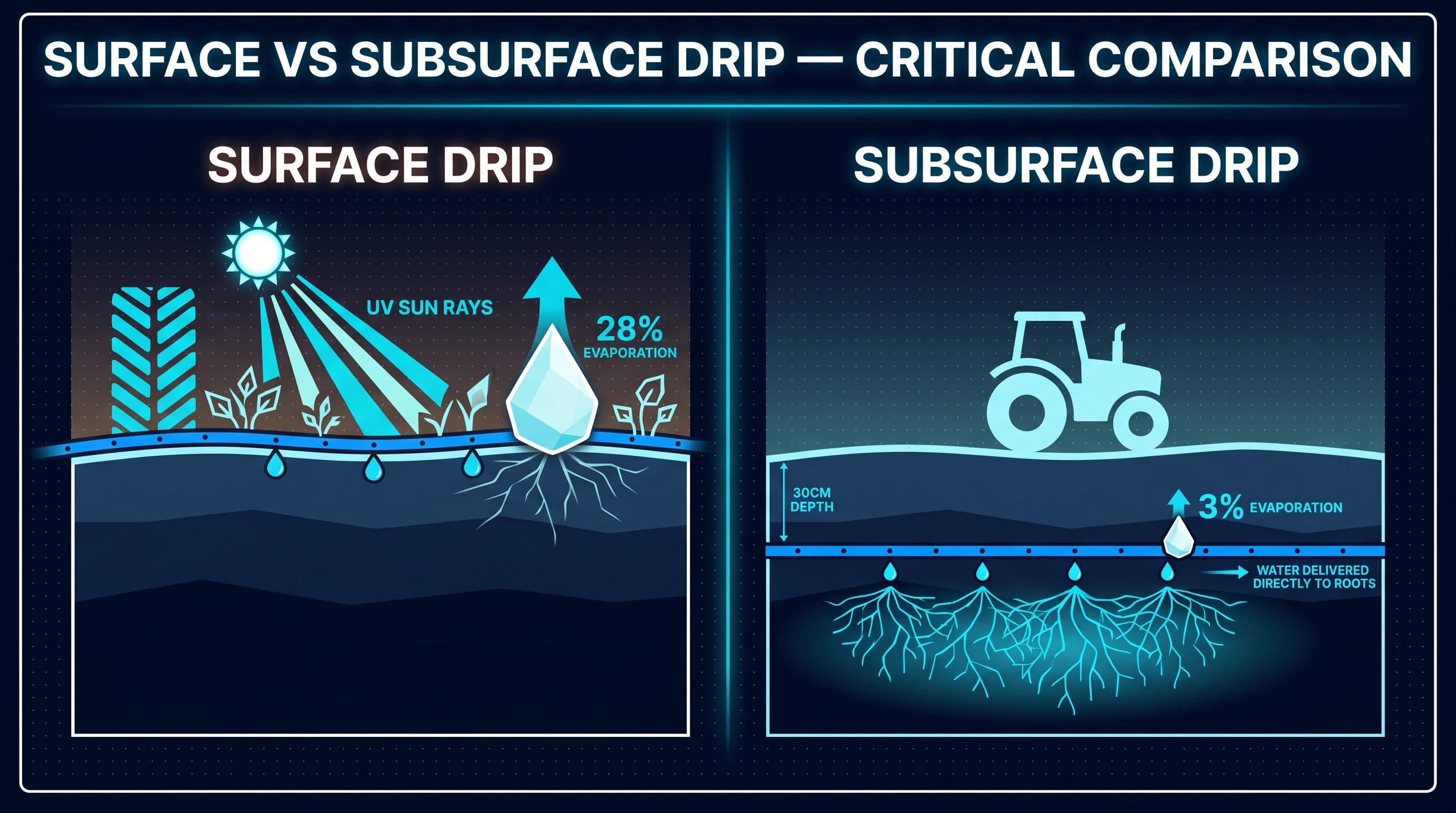
In surface drip the line lies on top of the soil; it ages from UV exposure, becomes overgrown with weeds, and must be removed before planting/harvest and re-laid each year. Evaporation loss ranges 20–35%.
In subsurface use the line is buried; there is no UV degradation, weed germination on surface drops (soil surface stays dry), tractor traffic does not affect the line, and evaporation loss falls below 3%. System service life is 15–20 years — versus 3–5 for surface systems.
Three most common clogging problems
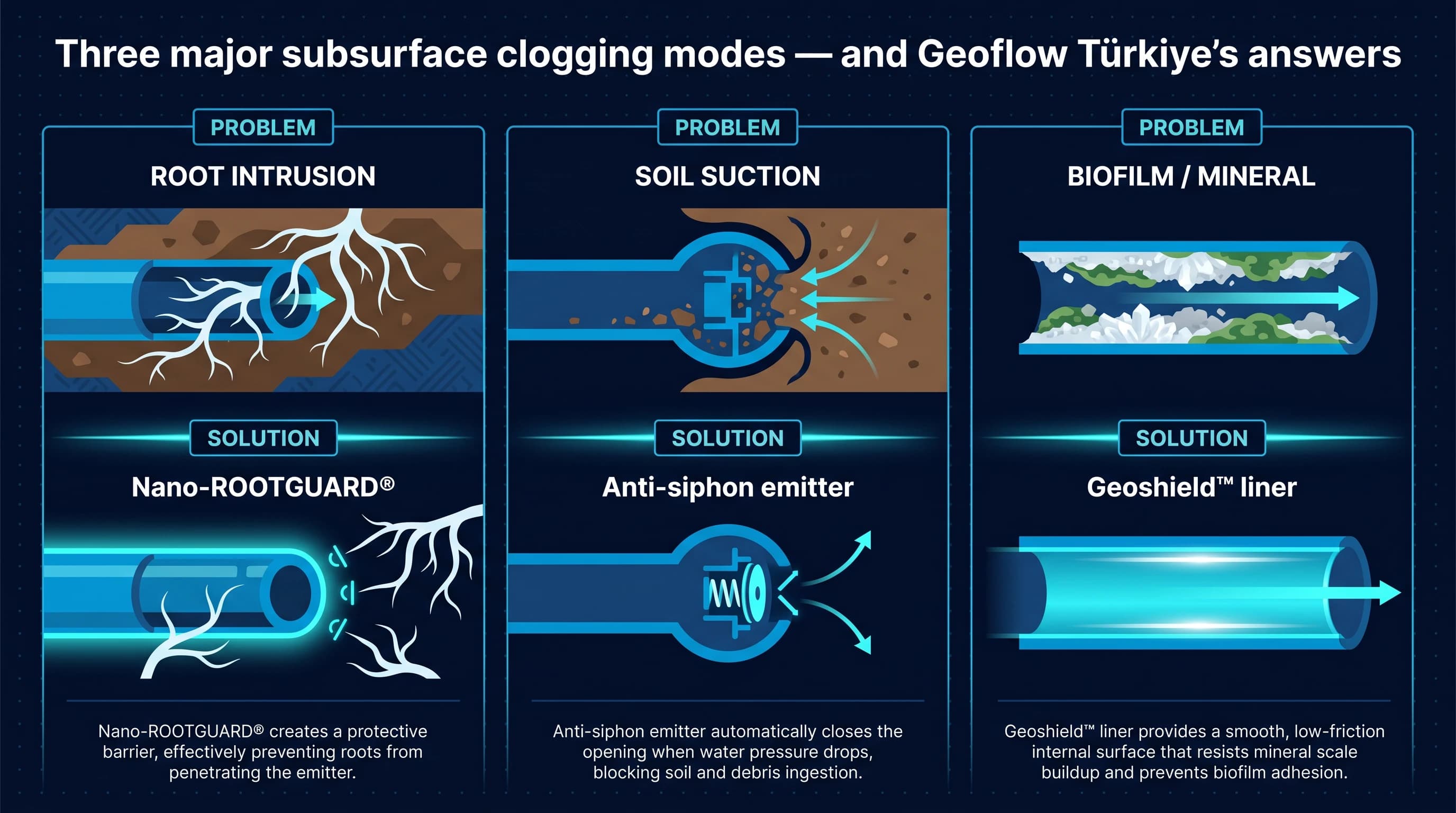
1) Root intrusion: plant roots eventually grow through the emitter outlet and block the line. The Nano-ROOTGUARD®-protected GEOFLOW line continuously releases a low-dose root-growth-stopping compound around the emitter — solved under a 10-year written warranty.
2) Soil suck-back: when irrigation stops, line drainage creates a vacuum that pulls sand and soil into the emitter outlet. Anti-siphon emitters such as ASSIF and VERED block this mechanically.
3) Mineral and biofilm buildup: high-lime water deposits calcium carbonate inside the emitter; treated water grows bacterial biofilm. Managed with correct filtration (120 mesh minimum), a periodic acid-flush program, and specialized lines such as WASTEFLOW with its internal Geoshield™ coating.
Per-crop design parameters
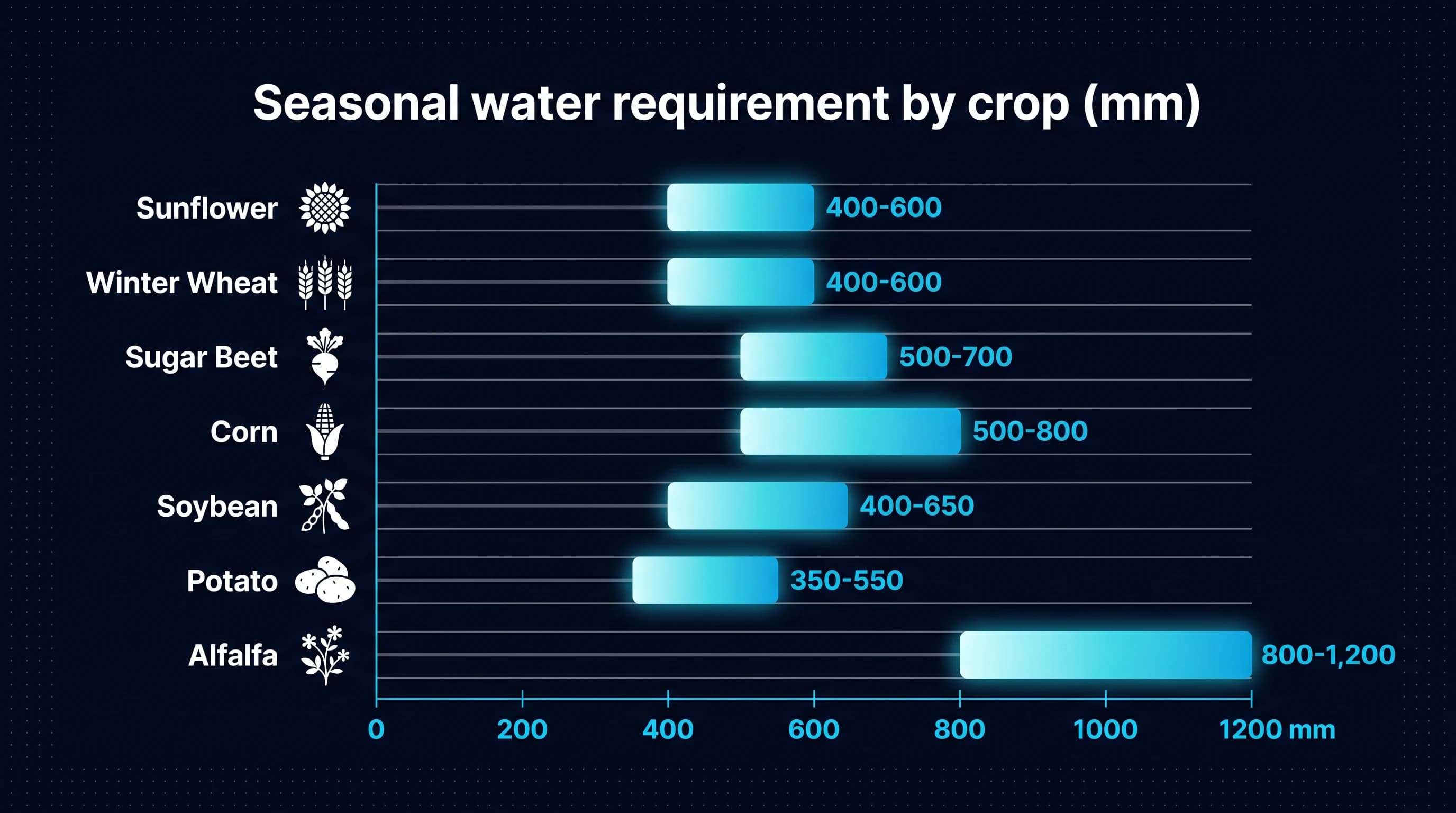
In subsurface drip each crop has its own appropriate burial depth, lateral spacing, emitter spacing, emitter flow rate, and seasonal water requirement. The typical ranges below come from Terra-Zenith project design outputs:
Sunflower: 25–35 cm depth, 70–100 cm lateral, 30–50 cm emitter, 400–600 mm seasonal water, 1.0–1.6 L/h. Winter wheat: 20–30 cm depth, 30–45 cm lateral, 25–40 cm emitter, 400–600 mm. Sugar beet: 25–35 cm depth, 45–60 cm lateral, 25–40 cm emitter, 500–700 mm. Corn: 25–35 cm depth, 70–90 cm lateral, 30–50 cm emitter, 500–800 mm. Soybean: 20–30 cm depth, 60–90 cm lateral, 30–50 cm emitter, 400–650 mm. Walnut: 40–60 cm depth, 80–120 cm lateral, 50–75 cm emitter, 700–1,000 mm, 1.6–2.3 L/h. Apple: 40–60 cm depth, 200–350 cm lateral, 50–75 cm emitter, 500–800 mm. Vineyard: 25–40 cm depth, 180–280 cm lateral, 40–60 cm emitter, 400–700 mm. Alfalfa: 25–40 cm depth, 70–100 cm lateral, 30–50 cm emitter, 800–1,200 mm. Full design parameters for all crops at /en/solutions.
Cost and payback
Subsurface drip capital cost depends on product line, lateral density, and filtration sizing. Indicative Russian-market range in 2025 is approximately 350,000–550,000 RUB per hectare (installation included, VAT excluded, pump station excluded). High-value orchards (walnut, vineyard, apple) typically pay back in 3–4 years; field crops in 5–7 years. Full cost guide at /en/cost/subsurface-drip-irrigation.
Sustainability and sector trend
Russia's southern grain belt (Krasnodar, Stavropol, Rostov, Voronezh) has experienced a measurable drying climate trend over the last decade. Maintaining production capacity through drought periods depends directly on irrigation infrastructure efficiency.
Conversion from surface and sprinkler to subsurface drip is a core water-management instrument for the Russian agro-industrial complex — both for the chernozem regions and the Volga basin where sunflower, winter wheat, sugar beet, and soybean dominate.
Frequently Asked Questions
Is subsurface drip suitable for every crop?
No. Crops with very shallow root depth (mushroom) or requiring continuous soil tillage (carrot nursery) are not suitable. Perennial orchards, row crops, field crops, landscape and turf are the best applications.
How long does the system last?
Because the line is not exposed to UV underground, field service life is typically 15–20 years. The manufacturer issues a 10-year written warranty against root intrusion (GEOFLOW line).
Can I bury my existing surface drip line?
No. Surface drip lines do not have Nano-ROOTGUARD® or anti-siphon protection; buried, they clog from root intrusion and soil suck-back within 1–2 years. Subsurface use requires a purpose-designed line like GEOFLOW.
Can I irrigate with treated water?
Yes. The WASTEFLOW line (with internal Geoshield™ coating) is purpose-designed for this. Conventional drip lines suffer bacterial biofilm buildup.
Is design consulting available?
Yes. Terra-Zenith provides site survey and agronomic design free of charge as part of project management. For materials-only orders we provide pre-design consulting on request.
Is filtration mandatory?
Yes. 120 mesh minimum disk or sand filter is mandatory. Without filtration, emitters clog within a single season and the system warranty is voided.
Preliminary design for your site
Share your area, crop, and water source — we'll send a preliminary design and cost estimate within 48 hours.