
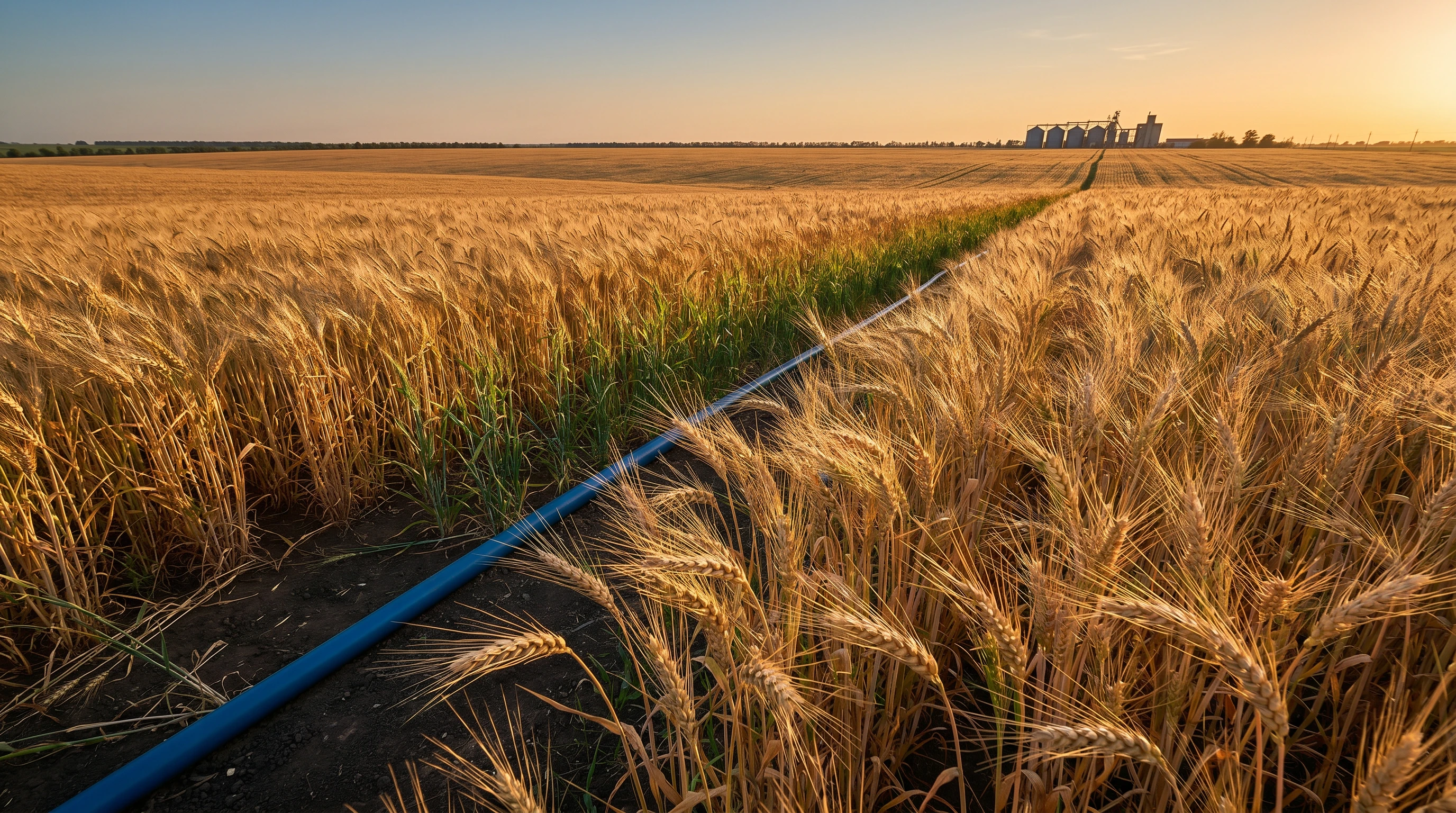
Winter wheat on chernozem — how drip irrigation moves yield.
Winter wheat is Russia's largest field crop: 28 million hectares, 35–40% of total grain production, the backbone of export revenue. Average national yield is 3.5–4 t/ha; best chernozem in Krasnodar — 5–6 t/ha; flagship Voronezh and Lipetsk farms — 6–7 t/ha. All of these numbers are **rain-fed**, on natural moisture.
The paradox: over the last ten years the classical grain regions — Krasnodar, Stavropol, Rostov — have seen measurable spring-rain decline. The May–June window, when wheat enters grain fill, comes dry more often. Subsurface drip irrigation delivers a step-change here: 7–8 t/ha at stable high gluten quality. This analysis explains why and how.
Why "grain has enough rain" no longer works
Classical Russian agronomy: winter wheat is a **non-irrigated** crop. That was true through the 2010s — Kuban precipitation in the growth window (October–June) ran 380–450 mm, covering the 400–500 mm physiological demand for 5–6 t/ha yield.
Climate change shifted the statistics. Rosgidromet data for 2014–2024:
**Krasnodar Krai:** April–June precipitation dropped 18–22% versus the prior 30-year baseline. Dry years (< 250 mm in the window) now occur 1 in 3 rather than 1 in 6. **Stavropol Krai:** sharper trend — 28–32% drop. The dry scenario became the norm. **Rostov, Voronezh:** 15–20% drop with rising variability.
In parallel — warming. Mean May temperature rose 1.5–2.2 °C, lifting evapotranspiration 12–18%. The rain that used to be "enough" is no longer enough.
Wheat physiology and three critical windows
Wheat reacts to water deficit in three key phases. If one window passes with more than 30 mm deficit — yield drops 0.7–1.2 t/ha.
**Window 1 — Tillering (October–November):** sets potential productive-stem count. Deficit weakens tillering, going into winter with an underdeveloped root. Subsurface here — 30–50 mm if October rains fail; a more frequent "insurance" run.
**Window 2 — Stem extension and heading (April–May):** sets potential spikelet and grain count per spike. The most "expensive" window — every missed mm costs the most. Norm 80–120 mm over 4–6 weeks, split into 4–6 events of 15–25 mm.
**Window 3 — Grain fill (late May–June):** sets 1000-seed weight. Coincides with peak heat in southern regions. Norm 80–100 mm over 3–4 weeks, fractionated (avoid drying stress).
Subsurface design parameters for winter wheat
Winter wheat is the highest-row-density crop a subsurface drip system is engineered for. 12.5–15 cm tape spacing yields **27–32 rows per hectare** — denser than any row crop.
**Burial depth:** 20–30 cm. Less than for row crops (25–35 cm) because wheat root mass is shallower — 0–40 cm dominant. Below 30 cm roots will not reach.
**Lateral spacing:** 30–45 cm. Each tape serves 2–3 wheat rows. Maximum yield runs 30 cm (every-2-rows). Best economy runs 45 cm (every-3-rows) — +10–15% yield vs rainfed at 30% lower system cost.
**Emitter spacing:** 25–40 cm. Tighter is more uniform but more expensive. 30 cm is the sweet spot.
**Emitter flow:** 1.0–1.6 L/h. Low flow is critical — high flow creates overwatering in tight rows and root-rot risk.
**Seasonal norm:** 400–600 mm. Three to four times sunflower's seasonal norm (same 400–600 mm), but distributed differently — bulk of volume goes in the stem-extension → grain-fill window.
Economics — why wheat pays back in 5–7 years
Subsurface drip for winter wheat is an investment in yield stability, not maximisation. That is important for the economics.
**Yield uplift vs rainfed:** +30–50% on best chernozem fields, +60–90% in drier zones (east Stavropol, trans-Volga). On a typical 100 ha Krasnodar project that lifts 5.5 t/ha to 8 t/ha = +250 tonnes per year.
**Secondary effects:** gluten rises from 22–23% to 26–28% (class 3 → class 2), realised price lifts 2,500–3,500 ₽/tonne. Moister wheat produces larger grain — 1000-seed weight 42–46 g vs 36–40 g.
**100 ha revenue impact:** 250 t × 18,000 ₽/t (average class 2–3) = 4.5 M₽/year gross, plus class premium 250 t × 3,000 ₽ = 0.75 M₽/year. Total 5.2–5.5 M₽/year incremental revenue.
**Investment:** 100 ha × 450,000 ₽/ha = 45 M₽ (typical wheat-project at 45 cm spacing).
**Simple payback:** 45 / 5.3 = **8.5 years**. With reclamation-support subsidies (typically 30–50% returned in 1–2 years) — real payback **5–6 years**.
Evidence base: the Geoflow Türkiye international network
Terra-Zenith is the Geoflow Türkiye authorised distributor for Türkiye and regional markets. That means the numbers above are not "promises from a new entrant" — they are the transfer of methodology proven across the international Geoflow Türkiye network to Russian chernozem.
**Geoflow Türkiye documented base:** more than 50 projects and over 2,000 hectares under subsurface drip — vineyards in the Aegean (20 projects, 600 ha, İzmir-Manisa), olive groves (5 projects, 410 ha, Turkey and Tunisia), corn (5 projects, 120 ha, Manisa, with documented **+29% grain**), cotton (with **+25%** uplift), and walnut (9 projects, 250 ha, Denizli-Manisa-Burdur). These results come from commercial field practice over three decades, not lab conditions.
**What transfers to Russian chernozem:** project methodology (burial depth, lateral spacing, norm calculation), emitter technology (Nano-ROOTGUARD®, anti-siphon), filtration parameters, winter-drainage protocol, factory warranty. What does **not** transfer automatically — specific yield numbers, because chernozem and chestnut soils respond differently than Aegean clay or Anatolian red. So the economic projections above are **adapted methodology with a ±15–25% sensitivity band** to real first-season outcomes.
**Russian pilot projects 2026:** launched in Krasnodar, Stavropol, and Voronezh. First-season results (yield, sugar content, gluten) publish in the journal as farms approve disclosure. Details available on request — see /references.
When subsurface drip does not make sense for wheat
Three scenarios where economics do not work:
**1) Very small area.** Below 30 ha — fixed cost of pump station, filtration, and engineering eats the project. Surface drip or sprinklers fit better.
**2) Low realisation price.** Without access to premium channels (port, export, miller), wheat sold to local market at 14,000–15,000 ₽/t makes 8–10 year payback hard to finance.
**3) Land leased under 10 years.** Subsurface is a 15–20 year asset. With 5–7 year leases and no renewal guarantee, asset loss risk at owner change.
For these scenarios we recommend surface drip for wheat (rare in Russia for grains but viable for 30–50 ha projects with 3–4 year payback on a 10-year horizon).
Frequently Asked Questions
Can subsurface be installed on already-seeded winter wheat?
No. Installation runs pre-seeding in the August–September window. On a seeded field, laying tape without damaging seedlings is physically impossible. Project starts one season before the first "irrigated" season.
Cold winters — will the system freeze under wheat cover?
See the dedicated guide [/learn/freeze-thaw-durability]. Short answer: at 25 cm depth on Krasnodar/Stavropol chernozem, frost line typically sits below the tape. Voronezh/Lipetsk requires 30 cm depth plus autumn drainage. PE material validated to −35 °C with line dry.
Compatible with modern combines and heavy machinery?
Yes. At 25–30 cm the line is protected from surface load. Standard equipment (combines up to 12 t, tractors up to 8 t) does not damage the line. Deep tillage (mouldboard or chisel below 22 cm) is prohibited — move to no-till or shallow till.
How does it combine with standard agronomy — sprays, fertilisers?
Cleanly. Herbicides and fungicides go via standard above-ground sprayers, no system interaction. Liquid fertilisers via fertigation in the subsurface line (25–30% uplift in nutrient-use efficiency). Granular NPK — standard at-seeding application.
What yield is realistic in a worst-case dry year?
Per the Geoflow Türkiye international network and methodology transfer to chernozem — even the driest year with subsurface does not drop below 5.5–6.2 t/ha. Subsurface transforms a rainfed "average-poor" scenario into an "average-good" one.
Can the system serve other rotation crops?
Yes, and recommended. Winter wheat rotates with sunflower, corn, soy, rapeseed on a standard 3–4 year cycle. The subsurface system serves all of them (irrigation norm changes; physical infrastructure is the same).
Forecast for your wheat project
Describe the field (area, region, average rainfed yield, water source) — we return a 10-year yield and economic projection with subsurface irrigation within 48 hours.