
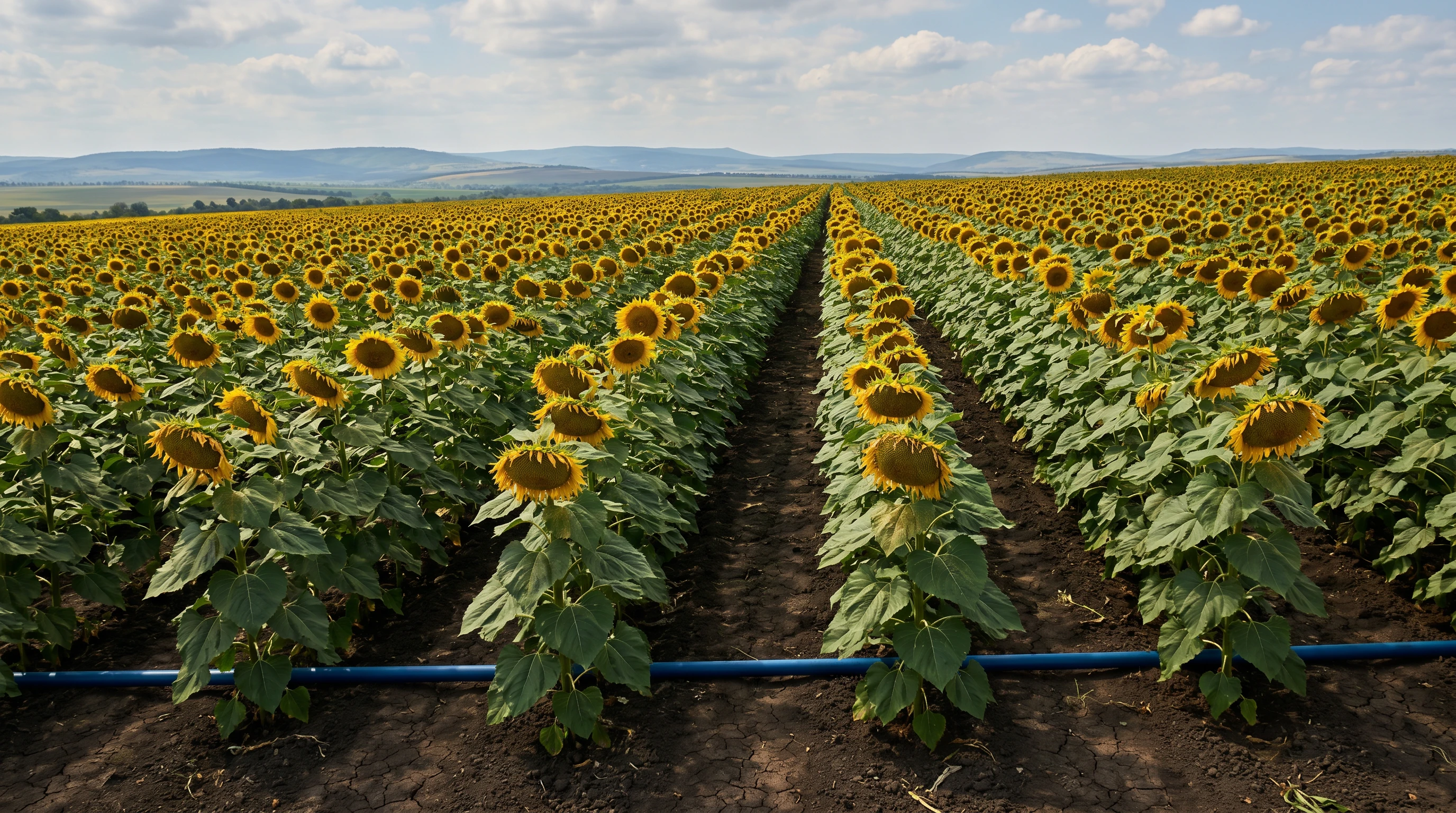
Peak-summer irrigation management — a playbook for sunflower, corn, and vineyards.
In July and August southern Russia sits at a stable +28 °C to +35 °C, relative humidity drops below 35%, and evening / night temperatures hold above +18 °C. This is the **critical physiological-stress window** for every summer crop — sunflower flowering, corn pollination, grape berry-fill. A mistake in the irrigation regime in this window costs 15–30% of yield; recovery before next season is impossible.
Unlike surface drip, subsurface drip line requires a regime revision in this phase — the buffering function of the lower 25–60 cm of soil behaves differently under extreme daytime temperatures. This guide collects seven practical rules that apply to a GEOFLOW subsurface system in Krasnodar, Stavropol, Rostov, and Voronezh projects.
1. Calculate by evapotranspiration, not by calendar
The standard agronomy table — "irrigate every 3 days at 30 mm" — is averaged for a cool early summer. In July heat, actual evapotranspiration (ETo) climbs from a typical 4–5 mm/day in June to **7–9 mm/day** in July–August on chernozem and chestnut soils of southern Russia.
**Practice:** base on field ETo (on-site weather station or open Rosselkhoztsentr data), multiply by the crop coefficient (Kc): sunflower at flowering 1.15, corn at pollination 1.20, vineyard at fill 0.85. Get the daily norm. A subsurface line with automated fertigation lets you split that norm into 2–3 short pulses per day — critical in peak heat.
**Rule of thumb:** at +30 °C and above, sunflower daily norm = 8 mm × 1.15 = 9.2 mm. For a 100 ha project that is 9,200 m³ per day — about 12 hours of operation on an 800 m³/h system.
2. Avoid midday irrigation
Counter-intuitively, at peak heat 13:00 you should not push the most water through. Subsurface irrigation in that hour is inefficient: water moves into a non-root evaporation layer at 5–10 cm and is lost. **Efficiency window:** 02:00–06:00 and 22:00–02:00, when soil temperature at 25–40 cm drops 2–3 °C and absorption recovers.
**Practice:** shift 70% of the daily norm into the night window. Keep a morning pulse for fertigation (if you need to sync with photosynthesis) — 30% of the norm in 30–45 minutes. This cuts thermal-stress risk and keeps roots active in the lower band.
3. Control inlet water temperature
Water from an open reservoir (pond, surface storage) heats to 26–30 °C in July. Delivering that to a 18–22 °C root zone creates **thermal shock** — fine roots die, uptake efficiency drops 20–25% for 3–5 days.
**Practice:** if the source is an open reservoir, set the intake at least 1.5 m below the surface (water there is 4–6 °C cooler). Alternative: night irrigation, when the reservoir cools to 19–21 °C. Borehole water is not affected — it stays at 10–14 °C year-round.
4. Protect filtration through the peak load
Open reservoirs and ponds see explosive algae growth in July — organic load is 3–5× spring values. A 120 mesh disk filter that runs maintenance-free in spring can clog **within 4–6 hours** in peak July.
**Practice:** in July–August set automatic backwash to every 3 hours (vs the standard 6–8). On sand filtration, every 2 hours. With a manual filter, the operator runs three backwashes per day in this window. Pressure differential before/after must stay within 0.2 bar — beyond that the filter is letting solids through.
**Warning:** systematic algae passage builds biofilm inside the emitter and undermines Nano-ROOTGUARD® protection — shortening service life. One season with clogged filters equals 3–5 lost years of asset life.
5. Strengthen potassium fertigation
Potassium is the most important nutrient in peak heat: it controls stomatal regulation and reduces transpiration loss. Sunflower potassium demand rises 30–40% in July vs the typical norm. Deficiency shows as marginal leaf burn and premature head closure.
**Practice:** fertigate 1.5–2.5 kg/ha/day of potassium (KNO₃ or K₂SO₄) every 2–3 days through the subsurface line in July. Parallel monitor — quick leaf assay on the 5–7th leaf from top every 10 days. Target sunflower leaf K: 3.0–3.5%; below 2.5% is critical deficiency.
6. Watch the stomatal stress index
If stomata stay closed more than 60% of daytime, photosynthesis drops 40–50% — and irrigation does not help. The plant cannot use the water because it will not open its stomata. This combines dry air (<30% RH) with temperature above +33 °C.
**Practice:** monitor with a basic infrared thermometer — measure leaf temperature at 12:00–14:00. If leaf temperature matches or exceeds air temperature, stomata are closed — wait for evening, save water. If leaf temperature is 2–4 °C below air temperature, stomata are open — irrigation works.
7. Prepare the system for August peak load
August is the heaviest month for the system: peak heat coincides with maximum crop water use. A breakdown in this period is expensive — every lost day in sunflower fill costs ~3% of yield.
**End-of-July readiness checklist:** 1) Full-pressure main flush, 5 minutes with end caps open. 2) Manual filter clean, disc/sand integrity check. 3) Test every auto-flush valve. 4) Inlet vs end-of-line pressure check — loss should not exceed 15% of design. 5) Stock of fittings and quick-connects for emergency repair on the hottest day. 6) Standby contact with Terra-Zenith — we run 7-day cover in August for Russian projects.
Frequently Asked Questions
Can I push the daily norm above 9 mm in peak heat?
Technically yes, but pointless — excess water moves below the root zone and is wasted. Better strategy: precise norm + potassium + cooler water + night schedule.
What to do if power fails during the peak?
A subsurface line does not need daytime irrigation in most scenarios. 12–24 hours without irrigation in the peak heat window is not critical with a healthy root system. Beyond 48 hours becomes dangerous.
Does the regime change for vineyard or other perennials?
Vineyard in berry fill needs **less water** (Kc 0.7–0.85) but **very stable supply** — abrupt swings cause berry split. Subsurface is the ideal delivery here.
How do I verify water reaches the root zone, not drainage?
Install tensiometers at 25 and 60 cm depth. Stop irrigation when the 60 cm sensor reads −25 kPa (moderately moist). Lower than that — excess water; higher — roots are thirsty.
Does this playbook apply to surface drip too?
Partly. Surface drip has higher peak-heat evaporation loss (up to 35% vs 3% subsurface), so daily norm needs to be 25–30% higher. This is one reason subsurface is economically superior in southern regions.
Audit your summer regime
Describe your project and current irrigation schedule — we audit and propose an optimised July–August regime within 48 hours. Free for active customers, nominal fee for new projects.